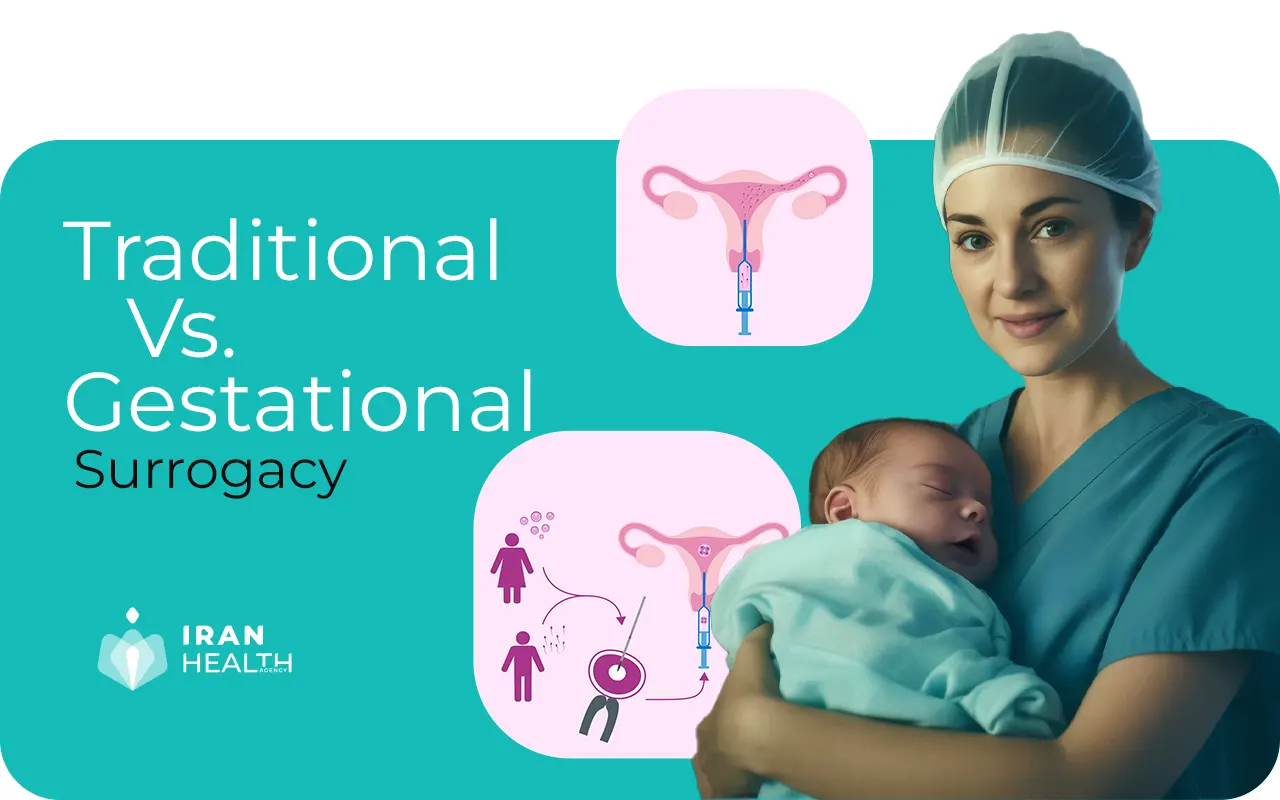
- Main Difference: In traditional surrogacy, the surrogate uses her own egg and shares DNA with the baby. In gestational surrogacy, she has no genetic connection.
- Medical Process: Traditional surrogacy usually uses artificial insemination (IUI). Gestational surrogacy requires IVF and embryo transfer.
- Genetic Parents: Gestational surrogacy allows eggs and sperm from intended parents or donors. One, both, or neither intended parent may be genetically related.
- Cost Comparison: Traditional surrogacy may have lower initial medical costs. Gestational surrogacy usually costs more due to IVF, medications, and embryo transfer.
- Legal Issues and Success Rates: Traditional surrogacy often involves more complex parental rights. Success depends on fertility health, egg quality, and treatment methods.
- Which Is Better? Gestational surrogacy is more widely available and often preferred for clearer genetic relationships. It is offered in Iran, subject to medical and legal eligibility.
Traditional vs. Gestational Surrogacy: Quick Comparison
Before exploring each process in detail, the following table highlights seven important differences between traditional and gestational surrogacy.
| Feature | Traditional Surrogacy | Gestational Surrogacy |
|---|---|---|
| Egg Source | The surrogate’s own egg | An intended parent’s or donor’s egg |
| Genetic Relationship | The surrogate is genetically related to the baby. | The gestational carrier has no genetic connection to the baby. |
| Fertility Treatment | Usually artificial insemination or IUI | IVF and embryo transfer |
| Intended Parents’ Genetic Link | The intended father or sperm provider may be genetically related. | One, both, or neither intended parent may be genetically related. |
| Legal Parenthood | Often more complicated because of the surrogate’s genetic relationship | May offer a clearer legal pathway, depending on local law |
| Medical Costs | May have lower initial medical costs if IVF is unnecessary | Usually includes IVF-related costs |
| Availability | Less commonly offered by fertility programs | More commonly used by modern surrogacy programs |
Key takeaway: Gestational surrogacy is generally the more widely available option, but neither approach is automatically suitable for every family. Medical eligibility, individual circumstances, and local laws are important factors.

What Is Traditional Surrogacy?
Traditional surrogacy, also known as genetic surrogacy or partial surrogacy, is an arrangement in which a surrogate becomes pregnant using her own egg and carries the baby for an intended parent or couple.
The sperm may come from an intended father or a donor. In most medically supervised arrangements, pregnancy is attempted through intrauterine insemination (IUI) or another form of artificial insemination.
Because the surrogate provides the egg, she is genetically related to the child. This genetic relationship is one of the most significant differences between traditional surrogacy and gestational surrogacy.
How Does Traditional Surrogacy Work?
The traditional surrogacy process usually involves several medical, psychological, and legal steps.
- Medical and psychological screening:The potential surrogate and other participants undergo appropriate health assessments, fertility evaluations, and psychological screening.
- Legal consultation:Each party receives independent legal advice about consent, parental rights, and the legal requirements of the surrogacy arrangement.
- Fertility treatment:Sperm is introduced into the surrogate’s reproductive tract, usually through intrauterine insemination around ovulation.
- Pregnancy monitoring:If conception occurs, the surrogate receives prenatal care and appropriate medical monitoring throughout pregnancy.
- Birth and parentage procedures:The necessary legal steps are completed according to the laws of the relevant jurisdiction.
Traditional surrogacy does not always require IVF, which can reduce certain treatment expenses. However, legal requirements may increase the overall complexity and cost of the arrangement.
Advantages of Traditional Surrogacy
Traditional surrogacy may offer some advantages in certain circumstances:
- No mandatory IVF: Egg retrieval and embryo creation may not be necessary when IUI is used.
- Potentially lower initial medical costs: Artificial insemination can cost less than IVF treatment.
- Alternative reproductive option: It may be considered when an intended parent cannot provide eggs, depending on medical circumstances and legal availability.
Disadvantages of Traditional Surrogacy
Despite these potential advantages, traditional surrogacy presents several important challenges:
- Genetic relationship: The surrogate is genetically related to the baby, which may complicate legal parenthood.
- Legal complexity: Establishing parental rights may require additional procedures.
- Limited availability: Fewer fertility clinics and surrogacy agencies offer traditional surrogacy.
- Emotional considerations: The surrogate’s genetic connection to the child may introduce additional emotional and family-related concerns.
- Different legal requirements: Some countries or states restrict or prohibit traditional surrogacy.
Any decision involving traditional surrogacy should include independent legal advice, appropriate counseling, and professional fertility guidance.


What Is Gestational Surrogacy?
Gestational surrogacy is an arrangement in which a person carries a pregnancy created through in vitro fertilization (IVF) using eggs and sperm from intended parents, donors, or a combination of both.
Unlike traditional surrogacy, the gestational carrier does not provide the egg used to create the embryo. Therefore, a gestational surrogate is not genetically related to the baby.
The embryo is created in a fertility laboratory and transferred into the gestational carrier’s uterus. If implantation is successful, the carrier continues the pregnancy and gives birth.
Gestational surrogacy may be considered when an intended parent cannot safely carry a pregnancy, does not have a uterus, or has another medical indication for surrogacy.
Whether intended parents qualify for gestational surrogacy also depends on the laws and medical requirements of the country where treatment takes place.
How Does Gestational Surrogacy Work?
The gestational surrogacy process involves several stages, beginning with medical consultation and continuing through IVF, pregnancy, childbirth, and legal parenthood procedures.
Step 1: Fertility Consultation and Medical Evaluation
The intended parents meet with a fertility specialist to discuss their reproductive history, medical conditions, and available fertility treatments.
The medical team evaluates whether gestational surrogacy is appropriate and determines whether donor eggs, sperm, or embryos may be necessary.
Step 2: Egg and Sperm Selection
Eggs and sperm may come from the intended parents, suitable donors, or a combination of these sources.
The choice depends on medical circumstances, personal preferences, and applicable legal requirements.
Step 3: IVF and Embryo Creation
During IVF, eggs are retrieved and fertilized with sperm in a laboratory. The resulting embryos are monitored for development.
Embryos may be transferred during a treatment cycle or frozen for future use, depending on the medical plan.
Step 4: Gestational Carrier Screening
The potential gestational carrier undergoes medical and psychological evaluations to assess her suitability for the arrangement.
Appropriate counseling, informed consent, and independent legal guidance are essential before treatment begins.
Step 5: Embryo Transfer
An embryo is transferred into the gestational carrier’s uterus using a medical procedure performed by a fertility specialist.
Embryo transfer does not guarantee pregnancy. If implantation is unsuccessful, additional treatment or another embryo transfer may be necessary.
Step 6: Pregnancy and Prenatal Care
After a positive pregnancy test and clinical confirmation, the gestational carrier receives regular prenatal care.
The medical team monitors the pregnancy and manages any health concerns or complications.
Step 7: Childbirth and Legal Documentation
After childbirth, the necessary legal parentage, birth registration, and other documentation procedures are completed according to applicable law.
For international intended parents, additional steps may include securing citizenship or nationality documentation, a passport, and permission for the child to travel home.
Advantages of Gestational Surrogacy
Gestational surrogacy offers several potential benefits for eligible intended parents:
- No genetic relationship between carrier and child: The gestational carrier does not contribute an egg.
- Possibility of genetic parenthood: Intended parents may use their own eggs and sperm when medically possible.
- Donor options: Donated eggs, sperm, or embryos may be used when appropriate and legally permitted.
- Established fertility programs: Gestational surrogacy is commonly offered through specialized fertility clinics.
- Legal pathways in some jurisdictions: Certain countries and states have procedures specifically addressing gestational surrogacy arrangements.
Disadvantages of Gestational Surrogacy
Gestational surrogacy also involves medical, financial, legal, and emotional considerations.
- Higher medical expenses: IVF, medication, embryo transfer, and possible repeated treatment can increase costs.
- Medical procedures: IVF may involve hormonal stimulation, egg retrieval, laboratory fertilization, and embryo transfer.
- No guaranteed success: Not every embryo transfer results in pregnancy or live birth.
- Legal requirements: Parentage and international documentation can remain complicated.
- Emotional considerations: Counseling and supportive communication are important for intended parents and gestational carriers.
The absence of a genetic relationship does not eliminate emotional considerations, legal obligations, or the importance of protecting the gestational carrier’s health, autonomy, and informed consent.

Are Surrogates Biologically Related to the Baby?
One of the most common questions about surrogacy is whether the woman carrying the baby shares DNA with the child.
A traditional surrogate is genetically related to the child because her own egg is used. A gestational carrier is not genetically related because the embryo comes from another egg source.
However, gestational surrogacy does not necessarily mean that both intended parents are genetically related to the baby.
Who Shares DNA With the Baby in Gestational Surrogacy?
The genetic relationship depends on the source of the egg and sperm used during IVF.
- Both intended parents: If the intended mother’s egg and intended father’s sperm are used, both contribute genetic material.
- One intended parent: If a donor egg is fertilized using the intended father’s sperm, only the intended father is genetically related.
- Neither intended parent: If donor eggs and donor sperm are used, neither intended parent is genetically related.
- Donated embryo: If a donated embryo is transferred, the intended parents may have no genetic relationship to the child.
The genetic relationship is determined by the egg and sperm providers, rather than by the person carrying the pregnancy.
Does a Gestational Surrogate Share DNA With the Baby?
No. A gestational carrier does not contribute the egg or sperm that determines the child’s inherited genetic material.
Although the gestational carrier provides the environment in which the fetus develops, this does not make her a genetic parent.
This distinction is one of the main reasons gestational surrogacy differs from traditional surrogacy in medical practice and legal parenthood arrangements.

Traditional vs. Gestational Surrogacy Costs
The total cost of surrogacy varies considerably depending on the country, fertility clinic, treatment plan, surrogate-related expenses, and legal requirements.
Traditional surrogacy may have lower initial medical costs because it can avoid IVF. Gestational surrogacy involves IVF and embryo transfer, which generally increase fertility treatment expenses.
However, the least expensive medical procedure does not necessarily result in the lowest overall surrogacy cost.
Legal services, medical complications, repeated pregnancy attempts, insurance, and support services may significantly affect the final amount.
What Determines the Total Cost of Surrogacy?
When comparing traditional and gestational surrogacy expenses, intended parents should consider the following categories:
| Cost Category | What It Includes |
|---|---|
| Medical Screening | Fertility tests, blood tests, infectious disease screening, and health evaluations |
| Fertility Treatment | IUI or IVF, fertility medications, laboratory services, and embryo transfer |
| Surrogate-Related Expenses | Permitted compensation, reimbursements, and other agreed support |
| Pregnancy and Delivery | Prenatal appointments, pregnancy monitoring, hospital delivery, and medical complications |
| Legal Expenses | Independent legal advice, contracts, parentage procedures, and documentation |
| Additional Services | Travel, accommodation, translation, coordination, and administrative assistance |
International intended parents should also consider the costs associated with travel documents, birth registration, nationality or citizenship procedures, and any additional stay required after childbirth.
How Much Does Gestational Surrogacy Cost in Iran?
Iran is one of the countries where gestational surrogacy services are offered through fertility programs.
Iran Health Agency has advertised gestational surrogacy programs starting at approximately $15,000, with a program described as a guarantee package starting at approximately $20,000.
These figures should be treated as advertised starting prices, not fixed costs or guarantees of a live birth. Current pricing, package terms, eligibility, and included services must be confirmed directly before treatment.
The final amount may depend on the fertility treatment plan, donor requirements, number of embryo transfers, pregnancy-related complications, and the exact services covered by the agreement.
Before signing any surrogacy contract, intended parents should request an itemized written quotation and ask what happens if IVF treatment is unsuccessful or additional medical care becomes necessary.
For more information, visit our Surrogacy in Iran: Costs and Process page.

Is Traditional or Gestational Surrogacy More Successful?
There is no single success-rate percentage that can fairly compare all traditional and gestational surrogacy arrangements.
Traditional surrogacy often uses intrauterine insemination (IUI), while gestational surrogacy requires IVF. These procedures involve different treatment methods, patient populations, and reproductive circumstances.
For this reason, comparing general success percentages without considering the underlying medical factors can be misleading.
What Factors Affect Surrogacy Success Rates?
Several factors influence the likelihood of pregnancy and live birth:
- Egg age and quality: The age and reproductive health of the egg provider can influence fertility outcomes.
- Sperm quality: Sperm-related factors may affect fertilization and embryo development.
- Embryo quality: In IVF, embryo development and characteristics can influence the likelihood of implantation.
- Surrogate’s reproductive health: Medical eligibility and uterine health are important considerations.
- Clinical standards: Laboratory performance, treatment protocols, and professional experience influence care quality.
- Previous treatment history: Earlier fertility outcomes may help specialists evaluate a proposed treatment plan.
Fertility clinics may report pregnancy rates, implantation rates, or live-birth rates. These measures are not interchangeable.
Intended parents should ask for relevant live-birth statistics and clarify whether results are reported per embryo transfer, treatment cycle, or another measurement.
A qualified fertility specialist can provide an individualized assessment based on medical history and the proposed treatment.
Legal Differences Between Traditional and Gestational Surrogacy
Surrogacy laws vary significantly around the world. Some countries permit certain surrogacy arrangements, while others restrict or prohibit them.
The legal distinction between traditional and gestational surrogacy is particularly important because it can affect how intended parents establish their parental rights.
Legal Considerations in Traditional Surrogacy
In traditional surrogacy, the surrogate provides the egg and is genetically related to the baby.
This relationship can create additional legal requirements regarding maternity, parentage, consent, and the transfer or establishment of parental rights.
Depending on the jurisdiction, intended parents may need court proceedings, consent-based arrangements, or adoption-related procedures.
Traditional surrogacy is not legally available in every jurisdiction, even where some forms of gestational surrogacy are permitted.
Legal Considerations in Gestational Surrogacy
In gestational surrogacy, the carrier is not genetically related to the baby. Some jurisdictions provide specific legal procedures through which intended parents can establish parenthood.
However, the absence of a genetic relationship does not automatically make the intended parents the legal parents.
Legal procedures may still involve contracts, court orders, birth registration, or other requirements.
What Should Intended Parents Check Before Surrogacy?
Before entering a surrogacy arrangement, intended parents should obtain independent legal advice addressing:
- Whether the intended surrogacy arrangement is legally permitted.
- Whether the intended parents meet local eligibility requirements.
- Whether compensated or altruistic surrogacy is permitted.
- How legal parenthood will be established.
- What rights and protections apply to the surrogate or gestational carrier.
- How the child’s birth will be registered.
- How citizenship, nationality, passports, and international travel will be handled.
International surrogacy arrangements require particular care because the laws of the treatment country and the intended parents’ home country may differ.
What Are the Medical and Emotional Risks of Surrogacy?
Both traditional and gestational surrogacy involve pregnancy and childbirth. Therefore, both arrangements carry potential medical and emotional risks.
Medical Risks for the Surrogate
Pregnancy-related risks may include:
- Gestational diabetes
- Hypertensive disorders, including preeclampsia
- Bleeding and other obstetric complications
- Premature delivery
- Cesarean delivery and related recovery risks
- Other complications affecting maternal or infant health
Appropriate prenatal care and medical monitoring are important throughout pregnancy.
Additional Medical Considerations in Gestational Surrogacy
Gestational surrogacy requires IVF. The person providing the eggs may undergo ovarian stimulation and an egg retrieval procedure.
These treatments have their own potential risks, including ovarian hyperstimulation syndrome and complications associated with egg retrieval.
Embryo transfer also does not guarantee pregnancy, and some intended parents may require more than one treatment attempt.
Emotional and Psychological Considerations
Surrogacy can involve complex emotions for intended parents, surrogates, and their families.
Psychological counseling, clear communication, realistic expectations, and independent support can help participants make informed decisions.
The gestational carrier’s medical autonomy, informed consent, privacy, and wellbeing must be respected throughout the process.
The American Society for Reproductive Medicine recommends appropriate screening, counseling, informed consent, and legal guidance in gestational-carrier arrangements.
Is Gestational Surrogacy Available in Iran?
Gestational surrogacy is available through fertility programs in Iran. However, treatment eligibility, legal requirements, and medical procedures must be assessed individually.
Iran Health Agency describes its current surrogacy programs as intended for married heterosexual couples with qualifying medical circumstances.
International intended parents should not assume that every form of surrogacy or every family arrangement is eligible for treatment in Iran.
Legal Considerations for Surrogacy in Iran
Iran does not have a single comprehensive surrogacy-specific statute governing every aspect of the process.
Surrogacy arrangements may involve fertility clinic requirements, contracts, family law principles, court procedures, and other applicable regulations.
For these reasons, intended parents should consult qualified legal professionals familiar with Iranian law and the laws of their home country before beginning treatment.
Important considerations may include:
- Medical and legal eligibility for treatment
- Requirements for marriage documentation
- Legal agreements involving the gestational carrier
- Establishment and recognition of parenthood
- Birth registration and official documentation
- Nationality and travel documents for the baby
- Recognition of the arrangement in the intended parents’ home country
The legal requirements for traditional surrogacy should be evaluated separately rather than assuming they are identical to those governing gestational surrogacy.
Why Do Intended Parents Consider Surrogacy in Iran?
Some international intended parents explore gestational surrogacy in Iran because of the availability of fertility treatment programs and their advertised costs.
However, choosing a surrogacy destination should involve more than comparing prices.
Intended parents should carefully evaluate:
- The experience and qualifications of the fertility specialists
- The clinic’s treatment methods and reported outcomes
- Medical screening and care provided to gestational carriers
- The transparency of package pricing and contract terms
- Legal parenthood and birth documentation procedures
- Access to independent legal advice
- Support available during pregnancy and after delivery
For information about available programs, visit Surrogacy in Iran.
Which Is Better: Traditional or Gestational Surrogacy?
There is no universally correct answer to whether traditional or gestational surrogacy is better.
For many intended parents, gestational surrogacy is the more commonly available option through established fertility programs.
It allows an embryo created through IVF to be carried by someone who has no genetic relationship to the child.
Traditional surrogacy may involve fewer fertility procedures in some circumstances, but it introduces a genetic relationship between the surrogate and the baby that can create additional legal and personal considerations.
When Might Traditional Surrogacy Be Considered?
Traditional surrogacy may be considered in limited circumstances when:
- The arrangement is legally permitted.
- The medical circumstances support the proposed approach.
- The participants fully understand the genetic relationship involved.
- Independent legal advice and psychological counseling are available.
- All participants provide informed and voluntary consent.
When Might Gestational Surrogacy Be Considered?
Gestational surrogacy may be considered when:
- An intended parent cannot safely carry a pregnancy.
- An intended parent does not have a uterus.
- There is another recognized medical indication for gestational surrogacy.
- Embryos can be created using intended-parent or donor gametes.
- The intended parents meet the legal and clinical eligibility requirements.
For many families, gestational surrogacy offers greater flexibility in the source of eggs and sperm while avoiding a genetic relationship between the carrier and child.
Nevertheless, the final decision should be based on individual medical circumstances, legal advice, available resources, and the wellbeing of everyone involved.
Frequently Asked Questions About Traditional and Gestational Surrogacy
1. What Is the Main Difference Between Traditional and Gestational Surrogacy?
The main difference is the source of the egg. In traditional surrogacy, the surrogate uses her own egg and is genetically related to the baby. In gestational surrogacy, an embryo created through IVF is transferred to a carrier who has no genetic relationship to the baby.
2. Does a Gestational Surrogate Share DNA With the Baby?
No. A gestational carrier does not provide the egg or sperm used to create the embryo. The baby’s inherited genetic material comes from the egg and sperm providers, not from the person carrying the pregnancy.
3. Is IVF Required for Gestational Surrogacy?
Yes. Gestational surrogacy requires IVF because an embryo must be created using eggs and sperm from individuals other than the gestational carrier. The resulting embryo may be transferred fresh or after freezing and thawing.
4. Is Traditional Surrogacy Cheaper Than Gestational Surrogacy?
Traditional surrogacy may involve lower initial medical costs when artificial insemination is used instead of IVF. However, additional legal expenses, repeated treatment attempts, pregnancy care, and other requirements can affect the total cost.
5. Can Intended Parents Use Donor Eggs in Gestational Surrogacy?
Yes. Gestational surrogacy can involve donor eggs, donor sperm, or donated embryos, depending on medical eligibility and applicable laws. The gestational carrier does not provide the egg used to create the embryo.
6. Is Gestational Surrogacy Legal Everywhere?
No. Surrogacy laws differ between countries and states. Some jurisdictions permit certain forms of gestational surrogacy, while others restrict or prohibit surrogacy arrangements. Intended parents should obtain independent legal advice before starting treatment.
7. Which Surrogacy Method Has a Higher Success Rate?
A universal comparison is not reliable because traditional surrogacy often involves IUI, while gestational surrogacy uses IVF. Treatment outcomes depend on egg quality, sperm quality, reproductive health, embryo development, and other clinical factors. A fertility specialist can provide an individualized assessment using relevant live-birth data.
Conclusion: Understanding Traditional vs. Gestational Surrogacy
The most important difference between traditional and gestational surrogacy is the genetic relationship between the person carrying the pregnancy and the baby.
In traditional surrogacy, the surrogate provides her own egg and is genetically related to the child.
In gestational surrogacy, an embryo created through IVF is transferred to a gestational carrier who does not provide the egg and is not genetically related to the child.
Gestational surrogacy is more commonly offered by modern fertility programs, but the appropriate option depends on medical suitability, costs, legal requirements, and the needs of everyone involved.
Intended parents should consult qualified fertility specialists and independent legal professionals before making a decision.
Considering Gestational Surrogacy in Iran?
Iran Health Agency provides information and coordination services for eligible intended parents considering gestational surrogacy in Iran.
Our team can help you explore available treatment packages, understand the general process, and learn about the medical and administrative steps involved.
Before proceeding, it is important to confirm your eligibility, understand the full expected costs, and obtain appropriate legal advice.
Learn more about our available surrogacy programs:
Explore Gestational Surrogacy Services in Iran
Contact Iran Health Agency to request information about program eligibility, treatment options, package inclusions, and expected expenses.
Medical and Research References
The following resources provide additional information about gestational surrogacy, assisted reproduction, and relevant medical or legal considerations.
- Cleveland Clinic:
Gestational Surrogacy - American Society for Reproductive Medicine (ASRM):
Recommendations for Practices Using Gestational Carriers - Archives of Iranian Medicine:
Challenges and Prospects for Surrogacy in Iran