
If you’re asking where surrogacy is legal, you are asking the right question first. This is exactly where every good surrogacy journey should begin, not with a clinic, not with a price tag, but with the law. Surrogacy rules differ from one country to the next, and treating them as if they were the same is how good people end up in very difficult situations.
Think of this guide as a conversation with an experienced medical team (Agency) who has seen this journey many times and wants you to walk in with clear eyes. We will go through the countries where surrogacy is legal, the ones where it is banned outright, and the ones sitting in a shifting gray zone.
Among the legal countries for surrogacy in 2026, Iran keeps coming up as a stable, affordable, and medically capable option for married couples, alongside long-standing choices such as the United States, Georgia, Colombia, and Mexico. None of these is automatically “the best” for you. The right country depends on your family structure, your budget, and how much legal certainty you need. By the end of this guide, you will know which countries actually fit your situation, not just which ones show up first in a search.
What Is Legal Surrogacy?
Before we compare countries, let’s slow down and agree on what we are actually talking about, because surrogacy covers more than one arrangement.
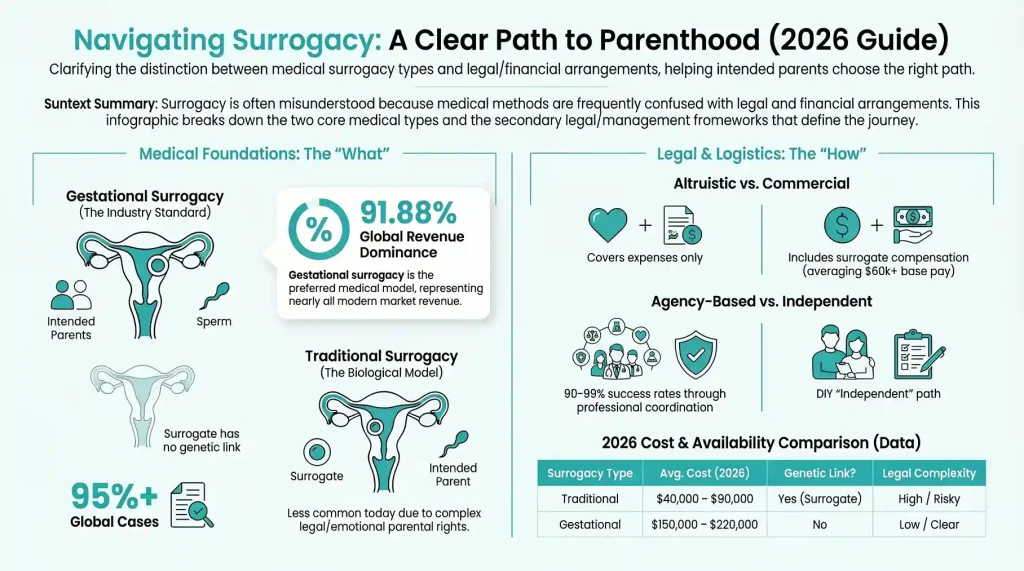
Gestational surrogacy is the version used in almost every modern program. The surrogate carries an embryo created through IVF using the intended parents’ eggs and sperm, or donor gametes. She has no genetic link to the baby. This is the model recognized by law in the United States, Iran, Georgia, Colombia, and most other regulated destinations.
Traditional surrogacy is older and far less common today. The surrogate’s own egg is used, so she is the biological mother as well as the birth mother. Because this creates a genetic tie, many countries either ban this form outright or treat it very differently from gestational surrogacy under the law.
Commercial versus altruistic surrogacy is the split that decides almost everything else: cost, waiting time, and how protected you are on paper. In commercial surrogacy, the surrogate receives a fee for her role, on top of medical and living expenses. In altruistic surrogacy, she may only be reimbursed for documented costs, with no additional payment allowed. Countries that permit commercial arrangements, like the United States and Iran, tend to have shorter waiting times because more women are willing to participate. Countries that require altruistic-only arrangements, such as the United Kingdom and Canada, often move more slowly because fewer surrogates come forward without compensation.
Where Is Surrogacy Legal in 2026?
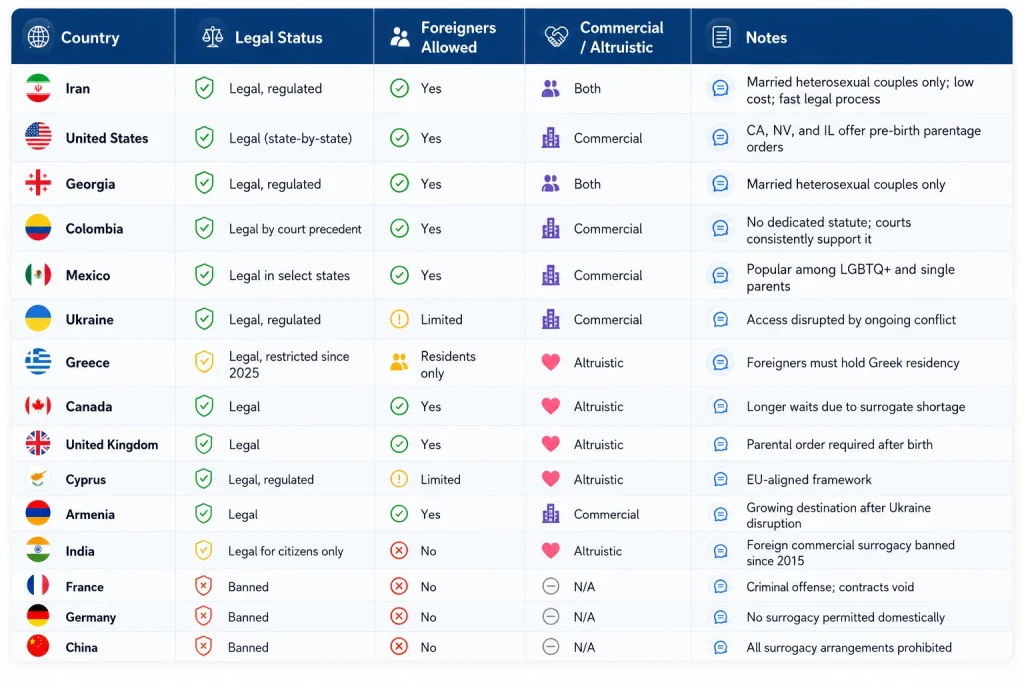
Here is a working snapshot of the countries where surrogacy is legal in 2026, with the details that actually change your plan: whether foreigners are accepted, whether the arrangement is commercial or altruistic, and what to watch for.
Countries Where Commercial Surrogacy Is Legal in 2026
Commercial surrogacy means the surrogate is paid beyond her expenses, and it is where most countries with legal surrogacy for international families sit today.
Iran has permitted both commercial and altruistic surrogacy since a landmark religious ruling in 1999 opened the door, later reinforced through licensed fertility centers regulated by the Ministry of Health. Iranian law recognizes the intended parents as the legal guardians once the surrogacy agreement is finalized, and the surrogate has no legal claim over the child. Eligibility is limited to legally married heterosexual couples with a documented medical need, such as an absent or damaged uterus. Costs typically run far lower than in Western destinations, often ranging from $15,000 to $30,000 for a full program, compared with well over $150,000 in parts of the United States. This price gap, combined with modern IVF facilities and experienced specialists, is a major reason Iran continues to attract couples from across the Middle East, Europe, and Asia.
Here are more details and data (complete information) on surrogacy in Iran.
- Georgia has allowed both commercial and altruistic arrangements since the early 1990s and remains one of the clearer legal frameworks in the region, though it is also limited to married heterosexual couples.
- Colombia has no dedicated surrogacy statute, but its constitutional court has consistently upheld surrogacy arrangements, creating a de facto legal and commercially viable path that is notably open to LGBTQ+ couples and single parents.
- Mexico allows commercial surrogacy in specific states, with Tabasco having tightened its rules in recent years while other states have stepped in to fill the gap. It remains one of the most cost-competitive options in the Americas.
- The United States does not have one federal surrogacy law. Instead, each state sets its own rules. States such as California, Nevada, and Illinois are considered the gold standard, offering pre-birth parentage orders that name intended parents on the birth certificate before the baby is even born. The tradeoff is cost, which can exceed $150,000 to $230,000 once medical, legal, and agency fees are combined.
Countries That Allow Altruistic Surrogacy
Not every family needs or wants a commercial arrangement. In altruistic surrogacy, the surrogate is reimbursed only for pregnancy-related costs, without an additional fee.
Iran also permits this route for couples who prefer it, alongside its commercial framework, under the same medical-need criteria.
- The United Kingdom allows altruistic surrogacy only. The surrogate is the legal parent at birth, and intended parents must apply for a parental order afterward, a process that can take several months.
- Canada follows a similar altruistic-only model. It is open to a wide range of family types, including single parents and same-sex couples, but the lack of compensation means fewer women volunteer as surrogates, so waiting times tend to be longer.
- Portugal permits altruistic surrogacy only under strict medical criteria, with court oversight built into the process.
- Greece, once a leading altruistic destination for foreigners, tightened its rules in May 2025 under Law 5197/2025. Both the intended mother and the surrogate must now hold legal residency in Greece for a court to approve the arrangement, effectively closing the door to most international applicants who do not already live there.

Countries Where Surrogacy Is Illegal
Some governments have chosen to prohibit surrogacy entirely, regardless of compensation model.
- France treats surrogacy as a criminal offense, and any contract between a surrogate and intended parents is legally void from the start.
- Germany does not permit surrogacy domestically under any form, commercial or altruistic.
- Italy has gone further than most. As of late 2024, Italian citizens who pursue surrogacy abroad can face prosecution at home, with the practice classified alongside other serious offenses under a universal crime framework.
- Spain does not recognize surrogacy contracts, leaving intended parents with no domestic legal path.
- China prohibits all surrogacy arrangements, commercial or altruistic, for citizens and foreigners alike.
If you are researching what countries allow surrogacy versus which ones ban it, this list of prohibitions is just as important as the list of options, because attempting surrogacy through informal channels in these countries carries real legal risk for everyone involved.
Can Foreigners Pursue Surrogacy Abroad?
This is usually the question underneath the question. Knowing that a country is on the list of legal surrogacy countries does not automatically mean you, personally, can use it. Five things decide whether the door is actually open to you.
Visa: Some countries require a specific entry visa tied to medical treatment, while others, like Greece since 2025, now require full legal residency rather than a visit.
Citizenship: Your home country’s citizenship rules matter as much as the destination country’s surrogacy law. A baby born abroad through surrogacy does not automatically inherit your citizenship everywhere; some countries require proof of a genetic link to at least one intended parent.
Birth certificate: Countries like Iran and Georgia list the intended parents directly on the birth certificate. Others, like the United Kingdom, initially list the surrogate, requiring a later legal transfer.
Passport: Getting your child a passport home can be the slowest step. Many governments, including the United States, ask for documented proof of genetic, gestational, and legal parentage before issuing travel documents.
Legal parentage: This is the foundation everything else rests on. In commercial-surrogacy nations such as Iran and the United States, parentage is typically settled quickly through the surrogacy contract and court recognition. In altruistic-only nations, a separate court order or adoption-style process is often required after birth, which can add months to your timeline.
If you are specifically comparing surrogacy legal countries for foreigners, build your checklist around these five items before you build it around cost.
Best Countries for Surrogacy
Once you know which countries with legal surrogacy are open to your family type, the next comparison is usually legal security, cost, waiting time, success rate, citizenship process, and how parentage laws are written. That comparison deserves more room than a short FAQ section can give it. We’ve broken down the strongest options side by side in a dedicated guide: What Are the Best Countries for Surrogacy.
Conclusion
Surrogacy law is not one global rulebook; it is dozens of separate ones, and they keep shifting. What was open in Greece two years ago is largely closed today. What was banned in Russia for foreigners is now permanently closed. Kenya only banned foreign surrogacy in late 2025. This is exactly why, before you commit to any legal countries for surrogacy, you sit down with both a fertility specialist and a lawyer familiar with your destination and your home country’s rules not after you have already signed a contract or started treatment.
If Iran fits your family structure and you want to talk through what the process, timeline, and legal protections actually look like in plain language, our team is here for exactly that conversation. Reach out for a consultation, and we’ll walk you through it the way a good doctor would: honestly, step by step, with your specific situation in mind.
Free Consulation

Frequently Asked Questions
Which countries allow commercial surrogacy?
As of 2026, the clearest options are Iran, the United States, Georgia, Colombia, Mexico, and Armenia. Rules on eligibility and cost vary by country and, in the U.S., by state.
Is surrogacy legal for foreigners?
In many of the countries where surrogacy is legal, yes, but not always without conditions. Iran, the U.S., Georgia, Colombia, and Mexico accept international intended parents. Greece now requires residency, and India restricts commercial surrogacy to its own citizens only.
Is surrogacy legal in Iran?
Yes. Iran has permitted both commercial and altruistic gestational surrogacy since a religious ruling opened the practice, later formalized through licensed fertility centers. It is available to married heterosexual couples, Iranian or foreign, who can show a documented medical need.
Is surrogacy legal in Europe?
It depends entirely on the country. Georgia, Cyprus, Portugal, and Greece, with residency restrictions, allow it in some form. France, Germany, Italy, and Spain prohibit it. This patchwork is exactly why “Europe” is not a single answer to where surrogacy is legal.
Is surrogacy legal in Canada?
Yes, in altruistic form only. Canada is open to same-sex couples, single parents, and married couples, though the lack of compensation for surrogates often means a longer wait to be matched.
Is surrogacy legal in the UK?
Yes, but only as an altruistic arrangement. The surrogate is the legal parent at birth, and intended parents must obtain a parental order afterward to transfer parentage.
What is the difference between commercial and altruistic surrogacy?
Commercial surrogacy pays the surrogate a fee in addition to her expenses. Altruistic surrogacy limits payment to documented, pregnancy-related costs only. The distinction shapes eligibility, cost, and how long the process takes almost everywhere.
Can same-sex couples pursue surrogacy abroad?
Yes, in destinations such as the United States, Colombia, Mexico, and Canada. Iran and Georgia currently limit surrogacy to married heterosexual couples due to local legal and religious frameworks.
Is surrogacy legal in India for foreigners?
No. India banned commercial surrogacy for foreign intended parents in 2015. Altruistic surrogacy remains available, but only to Indian citizens who meet strict marital and medical requirements.
Why did Greece restrict surrogacy for foreigners in 2025?
Following a 2023 clinic scandal involving allegations of trafficking, Greek lawmakers passed Law 5197/2025, requiring both the intended mother and the surrogate to hold Greek residency before a court will approve an arrangement.
Is it safe to pursue surrogacy in a country with no clear law?
Generally, no. Countries without a defined legal framework may allow surrogacy to happen in practice, but you have little protection if a dispute arises over parentage, payment, or the child’s documents. Legal clarity should weigh as heavily as cost in your decision.
Sources
- Wikipedia, “Surrogacy laws by country” https://en.wikipedia.org/wiki/Surrogacy_laws_by_country
- Growing Families, “Major Change to Greek Surrogacy Laws” https://www.growingfamilies.org/blog/major-change-to-greek-surrogacy-laws-what-it-means-for-international-intended-parents/
- Karpouzis Lianou Law Office, “New Legal Framework for Surrogacy in Greece (2025)” https://karpouzislianou.gr/en/new-legal-framework-for-surrogacy-in-greece-2025/
- Louisa Ghevaert Associates, “International Surrogacy Law Update 2025” https://louisaghevaertassociates.co.uk/international-surrogacy-law-update-2025/
- Physician’s Surrogacy, “The State of Surrogacy Laws Around the World: 2026 Country-by-Country Guide” https://physicianssurrogacy.com/blog/surrogacy-laws-around-the-world/
- OVU.com, “International Surrogacy Laws 2026: Legal Framework by Country” https://ovu.com/fertility-insights/international-surrogacy-laws-2026-legal-framework-by-country