Discovering that natural conception may not be possible because of severe male infertility can be emotionally overwhelming. Fortunately, advances in reproductive medicine have made parenthood possible for many couples through donor sperm treatment.
If you’re searching for reliable information about sperm donation in Iran, you’re probably asking important questions:Is sperm donation legal in Iran? Who can receive donor sperm? How much does treatment cost? Can international patients undergo IVF with donor sperm in Iran?
In this guide, you’ll find clear, evidence-based answers to each of these questions. We’ll explain how donor sperm is used in IVF, IUI, and ICSI, who qualifies for treatment, what the legal and medical process looks like, the expected costs, and what international patients should know before starting their fertility journey in Iran.
Sperm donation is an assisted reproductive treatment that helps individuals and couples achieve pregnancy when the male partner’s sperm cannot be used due to infertility, genetic concerns, or previous medical conditions.
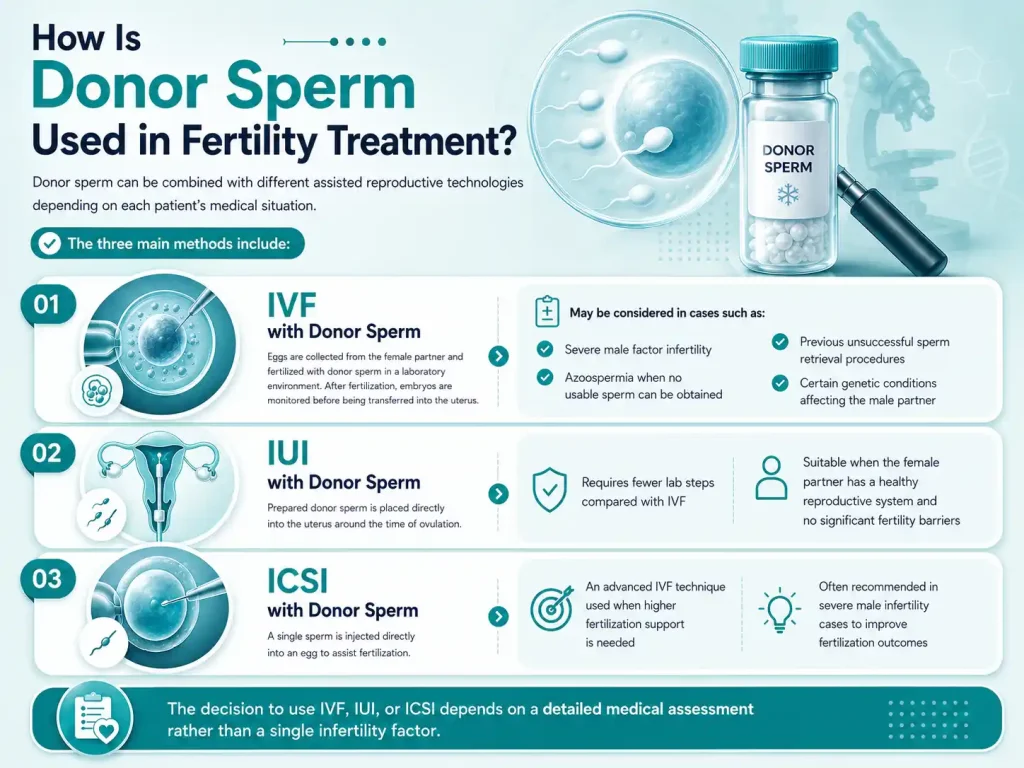
In this process, sperm from a donor is used to fertilize the woman’s egg through fertility treatments such as IVF, IUI, or ICSI. Donors are evaluated through medical history reviews, semen analysis, infectious disease testing, and genetic assessments to support the safety and effectiveness of treatment.
For couples exploring donor sperm in Iran, understanding how the process works is an important first step. The recommended treatment approach depends on the underlying cause of infertility, the woman’s reproductive health, and the evaluation performed by a fertility specialist.


It’s an important question; we break down the answer in the following bullet point:
Cancer Survivors: Chemotherapy and radiation can permanently damage sperm production. For men who didn’t preserve sperm before treatment, donor sperm can be the only route to conception with their partner.
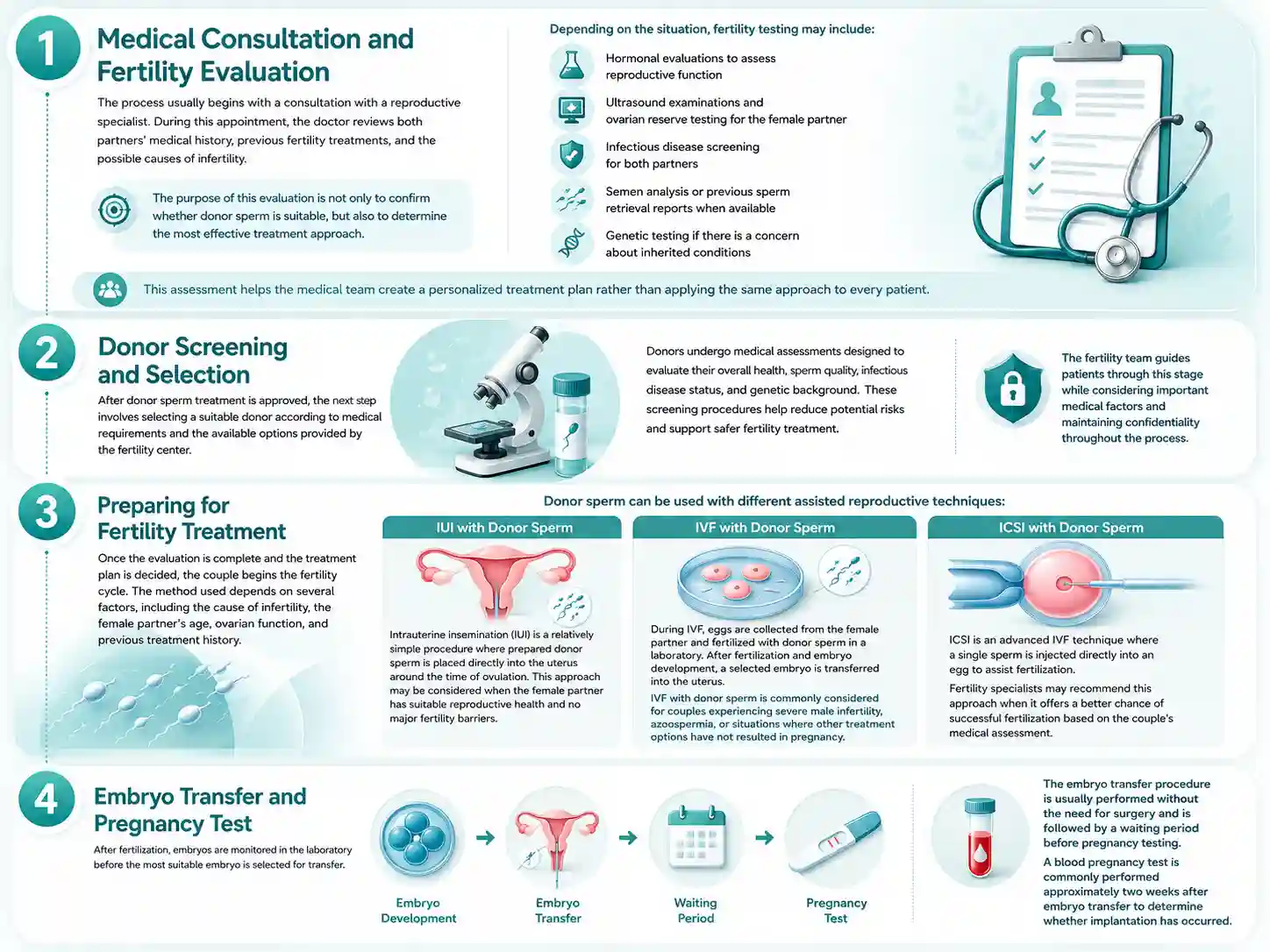
Starting fertility treatment with donor sperm can feel like a major decision, especially for couples who have already experienced unsuccessful treatments or a long journey with male infertility. Understanding each step of the process can help you feel more prepared and know what to expect.
Although the exact pathway may differ depending on your medical condition and the fertility center you choose, sperm donation treatment in Iran generally follows a structured process that includes medical evaluation, donor screening, fertility treatment, and pregnancy follow-up.
Clinics generally apply the following criteria, consistent with international donor screening norms: an appropriate age range (typically 20s to mid-30s), no significant personal or family history of heritable disease, normal semen parameters on repeated analysis, no high-risk lifestyle factors (smoking, substance use, high-risk sexual behavior), and a clean bill of health across infectious disease and genetic screening. Because gamete donation isn’t governed by a dedicated Iranian statute the way embryo donation is, individual clinics set and enforce these criteria internally, following the general medical and ethical guidelines set by the Ministry of Health.
Reputable clinics run a multi-stage process: a medical evaluation covering general health and family history, genetic screening for carrier status of major heritable conditions, a psychological assessment, comprehensive infectious disease testing (including HIV, hepatitis B and C, and syphilis), detailed semen analysis for count, motility, and morphology, and a final quality control step before any sample is released for use. The six-month quarantine and re-testing period described earlier is a critical part of this; it’s the same window international infectious disease guidelines recommend to catch infections that may not show up on an initial test.

For couples considering sperm donation in Iran, understanding the legal framework is an important part of planning treatment. The answer depends on the type of donor-assisted fertility treatment being considered.
In Iran,embryo donation has a clearer legal foundation than sperm-only donation. The Embryo Donation to Infertile Couples Act, approved in 2003, provides a legal framework for licensed fertility centers to help eligible infertile couples through embryo donation.
However, sperm-only donation does not have a separate and clearly defined legal framework in Iranian law. Because of this, fertility centers usually evaluate each case individually and guide patients toward treatment options that have stronger legal support.
Donor-assisted fertility treatment is generally considered for legally married couples who cannot achieve pregnancy using the husband’s sperm due to conditions such as:
Foreign couples can seek fertility treatment in Iran, including donor-assisted options, if they meet the medical and legal requirements.
International patients should be prepared to provide documents such as proof of identity and marital status. Requirements may vary depending on the treatment pathway and the patient’s nationality.
Because donor-assisted reproduction involves important issues such as parental status, documentation, and legal recognition, international patients are advised to consult with an experienced fertility clinic before traveling to Iran.
Understanding the legal pathway in advance helps couples choose the most appropriate treatment option and begin their fertility journey with greater confidence.
For couples dealing with severe male infertility, IVF with sperm donation in Iran can be a possible pathway to pregnancy when using the husband’s sperm is not an option or previous treatments have not been successful.
The treatment follows the standard IVF process, including ovarian stimulation, egg retrieval, fertilization in the laboratory, embryo development, and embryo transfer. The main difference is that donor sperm is used to fertilize the eggs instead of sperm from the male partner.
Before starting treatment, a fertility specialist evaluates the couple’s medical history, previous fertility attempts, and overall reproductive health to determine the most suitable approach. Factors such as the woman’s age, ovarian reserve, and uterine condition play an important role in planning the treatment.

The sperm donation cost in Iran depends on several factors, including the type of fertility treatment, required medical tests, medications, and the services provided by the fertility center. The overall cost may include:
Compared with many international fertility destinations, Iran is often considered a more affordable option for assisted reproductive treatments while providing access to experienced fertility specialists and advanced reproductive technologies.
For international patients, additional expenses may include translation services, accommodation, transportation, and medical coordination.
Because each patient’s treatment plan is unique, fertility clinics usually provide a personalized cost estimate after reviewing the couple’s medical situation and recommended treatment pathway.
Â
• Affordable. Bundled cycle costs run a fraction of US or UK pricing, even after factoring in travel.
• Experienced IVF specialists. Many Iranian reproductive endocrinologists trained internationally and have handled thousands of donor-gamete and embryo donation cases specifically, not just standard IVF.
• Modern IVF labs. Leading centers operate ISO-certified embryology labs with time-lapse incubators and long-established embryo freezing protocols.
• No long waiting lists. Most patients can have a treatment plan arranged within weeks of initial contact, unlike public healthcare systems in some Western countries.
• Personalized treatment. Because clinics manage their own donor pools directly rather than working through a national registry, matching and scheduling tend to be more flexible.
• International support. Major centers coordinate visas, interpreters, and travel logistics for patients arriving from outside Iran.
If you decide to move forward with treatment in Iran, the coordination around the medical side matters just as much as the clinical care itself. Iran Health Agency works directly with licensed, accredited fertility centers, reviews your medical records and case history before you travel, provides a dedicated interpreter for every appointment, arranges the full patient journey from visa support to accommodation, stays involved throughout your treatment cycle, keeps every cost transparent from the first quote, and remains in touch after you return home. If donor sperm or embryo donation is part of your path forward and you’d like an honest conversation about how your specific case would be handled legally and medically we offer a free consultation to walk through it before you commit to anything.

It’s genuinely in between. Embryo donation has clear legal backing under a 2003 law, but standalone sperm donation isn’t explicitly addressed by statute it operates in a religious and regulatory gray area, with most clinics routing eligible cases through the embryo donation framework instead.
A full cycle including consultation, medication, the IVF or ICSI procedure, and the donor program fee typically totals $2,500-$4,500, notably less than the $17,000-$28,000 range common in the US.
In Iran, this is generally limited to legally married heterosexual couples with a documented medical need. Single women and same-sex couples face significant restrictions specifically around donor sperm IVF, though other options like egg freezing remain accessible.
Through medical evaluation, genetic screening, psychological assessment, infectious disease testing, semen analysis, and a six-month quarantine period with retesting before any sample is used.
Yes. Reputable clinics screen donors for major heritable conditions as part of the standard evaluation process, consistent with international donor screening practices.
Egg freezing is a straightforward legal option for single women in Iran. IVF using donor sperm is more legally restricted for unmarried patients, and this is a conversation worth having directly and privately with a clinic before planning treatment.
This faces significant legal restriction in Iran under current regulations, since licensed clinics are generally authorized to treat married heterosexual couples. Some couples explore alternative legal structures, but this requires careful, private legal guidance specific to their situation.
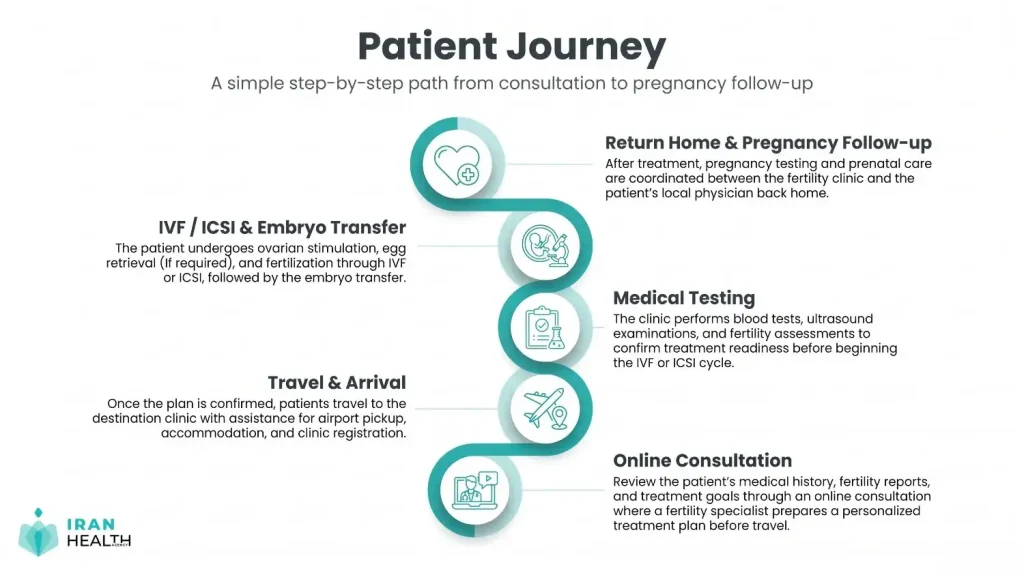
Most patients start with an online consultation to review medical history, followed by a treatment plan and travel arrangements once a doctor confirms eligibility and the appropriate pathway (donor sperm via embryo donation, standard IVF, or another option).
Typically, one full visit covers testing, the treatment cycle, and embryo transfer, followed by remote follow-up. Some cases involving additional diagnostic workups may require a shorter preliminary visit first.
Most cycles require roughly two to three weeks in-country, covering monitoring, the retrieval or insemination procedure, and embryo transfer.
Yes, and it’s strongly recommended. Reviewing your medical history and diagnosis remotely before booking travel helps confirm the right treatment path and avoids surprises once you arrive.