Egg Donation in Iran
Parenthood can be more complicated for some couples. Many women are denied passage through pregnancy by lack of egg quality or a reduced reserve egg capacity, or the cumulative disappointment of repeated unsuccessful treatment cycles of in vitro fertilization (IVF). When these factors prevent a couple from achieving their parenthood goal, an egg donor becomes the most suitable option.
International patients now flock to Iran for the cost of an egg donor for their own eggs in the Middle East, Central Asia, Europe, and Canada.
Iran has developed one of the finest egg donor programs in the world, comprising some of the best IVF Specialists and state-of-the-art treatment centers, and offering costs that are much lower, both financially and medically, than in the U.S. As well as other nations.
IHA covers everything you need to know: the legal framework, the step-by-step process, costs, egg donation success rates, risks, and what international patients can realistically expect upon arrival.
Free Consultation: Not sure if egg donation in Iran is right for you? Contact IranHealthAgency for a personalized assessment, no obligation.
What Is Egg Donation?
Egg donation (also called oocyte donation) is a procedure used for infertility. A fertile and healthy woman, called an egg donor, gives eggs to enable someone to conceive. The woman provides a person/couple with eggs that, once fertilized with sperm through IVF (In Vitro Fertilization) and/or ICSI (Intracytoplasmic Sperm Injection) in a laboratory, are implanted in the woman/mother-to-be. A child is born of the eggs of the donor and sperm of the father, but will gestate in another woman, to whom science attributed a role in the fetal development.
Unlike embryo donation, where both the egg and sperm come from third-party donors, IVF with donor eggs typically uses the intended father’s sperm, maintaining a partial genetic connection for the family.
Who Needs Egg Donation in Iran?
A woman may be a candidate for egg donation if it’s not medically possible to use her own eggs. This typically occurs in the following situations:
Advanced Maternal Age
Egg quality declines significantly after 35 and steeply after 40. According to CDC and SART data, IVF with a woman’s own eggs after age 40 often yields live birth rates in the low single digits, while IVF with donor eggs maintains a 45–55% per-transfer success rate regardless of recipient age. For women over 40, switching to a donor egg program is frequently the most evidence-based recommendation.
Premature Ovarian Failure (POF)
Premature ovarian failure also called primary ovarian insufficiency, causes the ovaries to stop functioning normally before age 40. Women with POF cannot produce viable eggs and require a donor.
Poor Egg Quality
Even with normal ovarian reserve, some women produce eggs that fertilize poorly or result in low-quality embryos. Poor egg quality is one of the leading causes of IVF failure and is not always predictable before a first cycle.
Repeated IVF Failure
Couples who have experienced two or more failed IVF cycles despite good embryo development are often advised to consider a donor egg IVF cycle to rule out egg-related factors.
Genetic Disorders
When a woman carries a hereditary condition she does not want to pass to her child, egg donation with a screened, healthy donor is a way to build a family while reducing genetic risk.
Is Egg Donation Legal in Iran?
This is the question most international patients ask first, and understandably so. The honest answer is nuanced, and we will give it to you straight.
Egg donation in Iran is practiced at licensed fertility centers and operates within a framework shaped by religious rulings (fatwas) and health ministry guidelines, rather than a single unified statute dedicated exclusively to egg donation. In 1999, Iran’s Supreme Leader issued a religious decree permitting assisted reproductive technologies, including egg donation for married couples. This landmark ruling, supported by subsequent fatwas from senior religious authorities, provided the medical community with a framework for providing these services legally and ethically.
Key points for patients to understand:
- Legal for married couples only. Single women are not eligible to receive donated eggs under current regulations.
- Licensed clinics only. Procedures must take place at Ministry of Health approved fertility centers, which are required to meet ethical screening and consent standards.
- Confidentiality is standard. Iranian clinics maintain strict donor anonymity; donors and recipients typically do not know each other’s identities.
- Egg donation differs from embryo donation. Iran also legally permits embryo donation under the formal Act on Embryo Donation to Infertile Couples. Egg donation (using only the donor’s egg and the recipient’s or partner’s sperm) operates under a different, religiously-grounded framework.
- International patients are accepted. Foreign couples including Muslims from other countries who prefer a donor of similar cultural background regularly receive treatment at Iranian clinics.
We want to be clear:
There is no single, comprehensive written law labeled the Egg Donation Act in Iran. The legal basis rests on religious authority, ministerial guidelines, and established clinical practice. Patients should discuss the specific framework with their chosen clinic and, if needed, a legal advisor familiar with Iranian health regulations.
How Does Egg Donation Work in Iran? Step-by-Step
The egg donation process in Iran typically takes four to six weeks from start to embryo transfer. Here is how it unfolds:
- Initial Consultation: You meet with a fertility specialist to review your medical history, test results, and suitability for egg donation. This can begin remotely for international patients.
- Medical Evaluation: The recipient undergoes hormonal testing, uterine assessment (hysteroscopy or ultrasound), and general health checks. The partner provides a semen analysis.
- Donor Matching: The clinic presents anonymous donor profiles including age, physical traits, blood type, education, and health history and you select a suitable match.
- Donor Screening: The selected donor undergoes comprehensive medical, genetic, hormonal, and psychological assessments before being approved.
- Ovarian Stimulation: The donor receives hormonal injections for 10–14 days to stimulate the production of multiple eggs. Progress is monitored via ultrasound.
- Egg Retrieval: Eggs are collected via a minor outpatient procedure under sedation. The recipient simultaneously prepares her uterine lining with hormonal medication.
- Fertilization (IVF/ICSI): Collected eggs are fertilized with sperm in the laboratory. Embryo quality is assessed over 3–5 days.
- Embryo Transfer: One or two high-quality embryos are transferred to the recipient’s uterus. This is a brief, usually painless procedure.
- Pregnancy Test: A blood test (beta-hCG) is performed approximately 10–14 days after transfer to confirm pregnancy.
Can International Patients Receive Egg Donation in Iran?
Yes. International patients from the Middle East, Arab countries, Central Asia, Europe, and Canada regularly travel to Iran for egg donation treatment. Iran’s clinics are experienced in handling the logistics of medical tourism, and several agencies provide end-to-end support including accommodation, translation, and travel coordination.
Documents typically required for international patients:
• Valid passport (both partners)
• Official marriage certificate (often requires notarization and translation)
• Medical records including hormone tests, ultrasound reports, and prior fertility workups
• Previous IVF cycle reports, if applicable
Many clinics allow the initial consultation and medical record review to happen remotely, minimizing the time you need to spend in Iran. Most international egg donation cycles can be completed in two to three weeks on-site, depending on your uterine preparation protocol.
Egg Donation Cost in Iran (2026)
Cost is one of the most compelling reasons international patients choose Iran. According to multiple Iranian fertility providers, a complete egg donation package in Iran, including donor matching, medical consultations, medications, the IVF procedure, and embryo transfer typically ranges from $4,000 to $7,300 USD in 2026. Some clinics offer all-inclusive packages at around $6,500, covering consultation, tests, ultrasounds, donor compensation, and the IVF cycle.
How does that compare internationally?
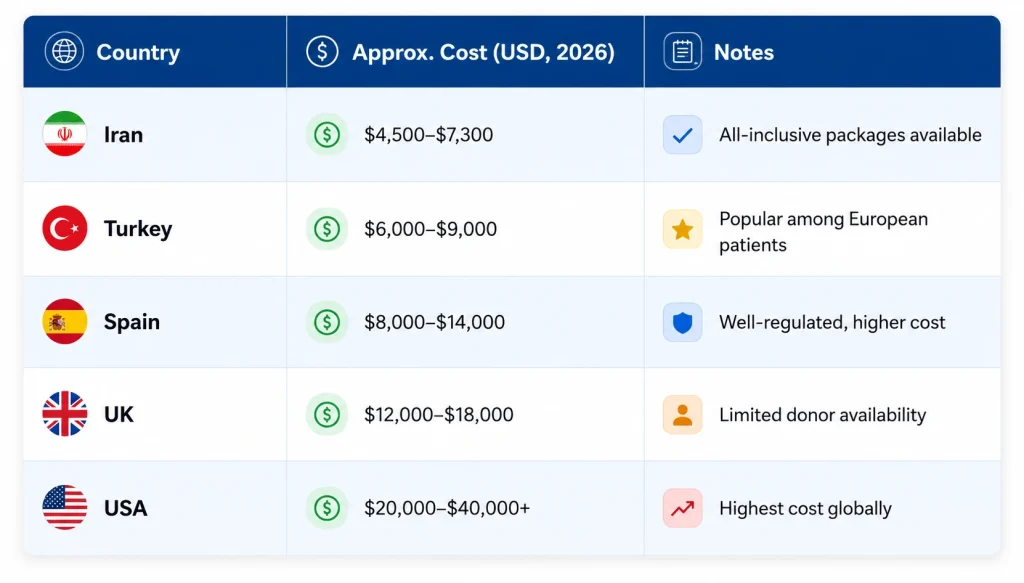
Factors that can affect the final cost include the number of embryos transferred, the need for additional testing (such as PGT-A genetic screening), medication protocols, and the specific clinic chosen. Travel, accommodation, and visa costs are additional for international patients.
Want a cost estimate for your specific situation? Request a free quote from IranHealthAgency. Packages are tailored to your medical profile.
Egg Donation Success Rates in Iran
Understanding egg donation success rates requires context. According to OVU.com’s 2026 IVF data guide, which draws on CDC and SART national reports, donor egg IVF maintains a 45–55% live birth rate per transfer across all recipient ages. This is a key advantage over using your own eggs after age 40, when rates can fall well below 10%.
Iranian clinics report comparable figures. For example, IHA reports 50–55% success rates per cycle for fresh donor eggs, with frozen-egg cycles maintaining 40–45%. TebMedTourism states the overall egg donation success rate in Iran reaches 50–60% per cycle.
For broader context, EggDonationFriends notes that CDC data shows fresh donor egg cycles produce a clinical pregnancy rate of about 53.9%, with live birth rates approximately 8–10% lower. Many clinics also report cumulative success rates approaching 90% over three cycles.
Key factors that influence egg donation success rates in Iran:
- Donor age: Donors in Iranian clinics are generally between 21–35, the optimal range for egg quality.
- Embryo quality: The laboratory’s skill in culturing embryos to blastocyst stage significantly affects outcomes.
- Recipient uterine health: A well-prepared endometrium is critical for implantation.
- Clinic experience: Established Iranian IVF centers with dedicated embryology labs consistently outperform smaller facilities.
Number of embryos transferred: Transferring two embryos increases pregnancy chances but also raises the risk of multiple pregnancies. Around 40% of donor egg cycles involving multiple embryos result in twins.
Risks and Considerations
Egg donation is generally safe and well-tolerated, but like all medical procedures, it carries risks that every patient should understand clearly.
Recipient Risks
- Multiple pregnancy (twins or more) if more than one embryo is transferred
- Mild side effects from hormonal medication (bloating, mood changes, headaches)
- Small risk of failed implantation, requiring a repeat cycle
Donor Risks
- Ovarian Hyperstimulation Syndrome (OHSS) a rare but potentially serious response to stimulation drugs; reputable clinics monitor closely to prevent severe cases
- Minor bleeding or discomfort following egg retrieval surgery
Emotional Considerations
Deciding to use donor eggs is a significant emotional step. Many couples feel grief about not using their own genetic material, alongside hope about the path forward. Counseling offered by most quality Iranian clinics is an important part of the process, not an afterthought.
Why Choose Iran for Egg Donation?
• Experienced fertility specialists: Iran has a long history of fertility medicine and a large pool of subspecialist reproductive endocrinologists.
• Advanced IVF centers: Major cities particularly Tehran host laboratories with current-generation embryology equipment.
• Short waiting times: Compared to the UK or Canada, donor matching in Iran typically takes days to a few weeks rather than months or years.
• Cultural and religious compatibility: Muslim couples from across the region specifically seek Iranian donors who share their cultural background, religious values, and physical characteristics.
• Affordable costs: As shown in the comparison table above, egg donation costs in Iran are a fraction of what patients pay in the US or Western Europe.
• International patient services: Clinics and agencies like IranHealthAgency offer coordination support, English-language communication, accommodation assistance, and airport transfers.
Frequently Asked Questions (FAQ)
Is egg donation allowed in Iran?
Yes. Egg donation is practiced legally at licensed Iranian fertility centers, under a religious and ministerial framework established since 1999. It is restricted to married couples, and procedures must take place at Ministry of Health–approved clinics.
Can unmarried women receive egg donation in Iran?
No. Current regulations in Iran restrict egg donation to married couples. Single women are not eligible under the existing framework.
How much does egg donation cost in Iran in 2026?
A complete egg donation package in Iran typically costs between $4,500 and $6,500 USD, covering donor matching, medications, the IVF cycle, and embryo transfer. This compares to $20,000–$40,000+ in the United States.
What is the success rate of egg donation in Iran?
Iranian clinics report success rates of 50–60% per cycle for fresh donor egg IVF, consistent with CDC-reported global averages of around 45–55% per transfer. These rates do not vary significantly with recipient age when donor eggs are used.
How long does the egg donation process take in Iran?
Most cycles take four to six weeks from start to embryo transfer. International patients typically need to be physically present in Iran for two to three weeks.
Do I need to know the egg donor personally?
No. Iranian clinics follow a strict anonymous donation model. You select a donor based on an anonymous profile (age, blood type, physical traits, health background) without personal contact.
Can I bring frozen embryos back to my home country?
This depends on your home country’s laws on importing embryos. Some patients freeze embryos in Iran and return for a frozen embryo transfer (FET) at a later date, while others take embryos home. You should consult a legal advisor in your country before planning this.
Is egg donation different from embryo donation in Iran?
Yes. Embryo donation where a donated embryo created from third-party eggs and sperm is transferred to the recipient is governed by Iran’s formal Act on Embryo Donation. Egg donation uses the donor’s egg combined with the recipient’s partner’s sperm, and operates under a separate religious and clinical framework.
Are the donor eggs genetically screened?
Yes. Donors undergo comprehensive health, hormonal, genetic, and psychological screening before being approved. Some clinics also offer PGT-A (preimplantation genetic testing of embryos) as an additional option.
Does IranHealthAgency help with the full process?
Yes. IranHealthAgency connects international patients with vetted, licensed fertility clinics in Iran and provides support throughout the process from initial consultation and donor matching to travel coordination and follow-up care.
Conclusion
Egg donation in Iran offers a meaningful, medically credible, and significantly more affordable path for couples who cannot conceive using their own eggs. With success rates of 50–60% per cycle, experienced fertility specialists, licensed Best VF centers, short waiting times, and a cultural environment that many international patients, particularly Muslim couples, find familiar and comfortable, Iran has become a genuine destination for reproductive medical tourism.
The legal framework is not a single statute but a well-established combination of religious guidance and ministerial oversight. Patients should enter the process with clear information and the support of experienced coordinators. Done right, IVF with donor eggs in Iran is a well-supported, evidence-based option that thousands of couples have successfully navigated.
Ready to take the next step? Contact IranHealthAgency today for a free, no-obligation consultation. Our team connects you with vetted fertility clinics in Iran and guides you from your first question to your last embryo transfer with care, transparency, and expert support at every stage.
Want to learn more about donation options?
IranHealthAgency: All-in-one destination for doctors’ consultations
We can assist you in arranging consultations with accredited physicians in Iran who specialize in various medical fields. We can also help you schedule the required medical tests. Moreover, we can facilitate money transfers and payments to healthcare providers, if necessary. Finally, we can help you submit verification requests and documentation to obtain donation approval. Please let me know how I can be of assistance.
For more information Contact us:


As someone who needed an egg donation, I was worried about the process in another country. The Iran Health Agency made it easy to find a donor, make sure everything was legal and ethical, and keep the process safe for everyone. I couldn’t be more thankful.