
Surrogacy in Islam: A Sunni Perspective
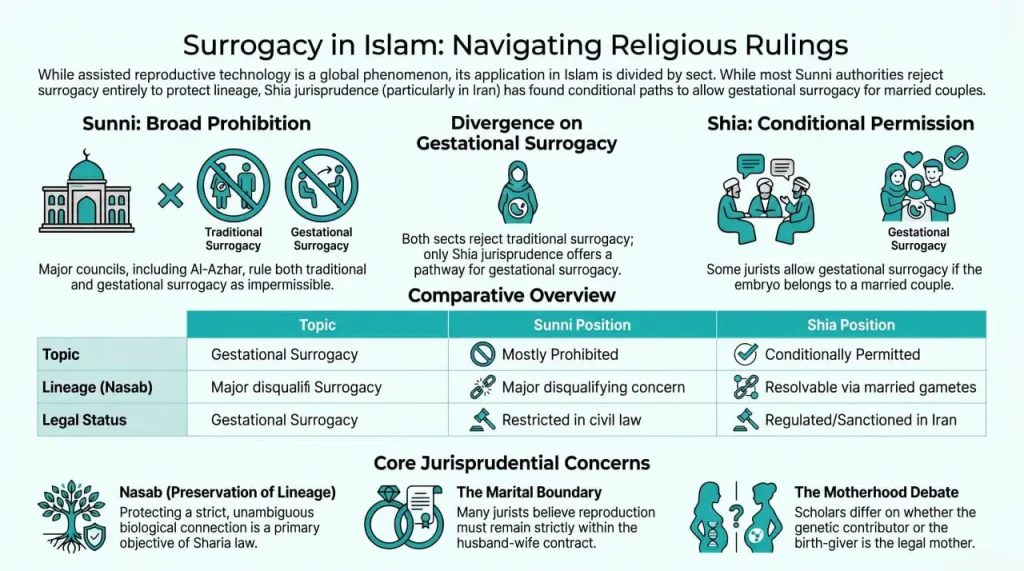
While there is no single supreme Sunni religious authority on the matter, a handful of well-known Fiqh (Islamic Law) organizations have officially ruled on it, and their rulings converge on one point. The Islamic Fiqh Academy in Mecca issued an opinion in 1985, which the International Islamic Fiqh Academy endorsed in 1986 -both ruled surrogacy is prohibited [2]. Egypt’s Islamic Research Academy confirmed a similar view in 2001, and similar opinions have been expressed by Al-Azhar University, the office of the Saudi Grand Mufti, etc.
Sunni Islam does not have a single central religious authority, but several major fiqh bodies have addressed surrogacy directly, and their conclusions point in the same direction. The Islamic Fiqh Academy in Mecca ruled on the question in 1985, and the International Islamic Fiqh Academy followed with a resolution in 1986; both found that pregnancy for the benefit of a third party is impermissible [4].
The rationale behind surrogacy in Islamic Sunni practice has its roots in the aforementioned “third-party problem”. Since surrogates do not enter into the marriage covenant with the genetic father, many Sunni scholars see the act of introducing his sperm, or an embryo thereof, into her body as equivalent to intercourse outside of marriage, which is strictly prohibited by the sharia, regardless of the lack of physical contact 3]. This holds true for both gestational and natural surrogacy, and the fact that there is no genetic relation between the surrogate and child is considered an insufficient counterargument for most Sunni authorities, a view differing from some of their Shia counterparts.[4]

Within Sunni law, the Hanafi school has been implicated in a very limited, conditional exception to this restriction. Some 20th-century Hanafi-influenced jurists – including proposals by the Syrian scholar Sheik Mustafa al-Zarqa – have debated that an unborn child carried by a husband’s second wife that originated from his sperm and his first wife’s egg, may be allowed due to the exclusion of all third parties[2]. While a Hanafi fiqh academy provisionally agreed to this proposal in one meeting, they subsequently decided against it, making the acceptance of such a concept still something of a minority viewpoint, rather than mainstream Hanafi practice[2] While within Sunni Islam, for Muslim couples, surrogacy is still often discouraged through Hanafi jurisprudence, the second-wife concept remains a more often cited footnote rather than an accepted solution.
Surrogacy in Islam Shia Perspective
Shia jurisprudence has reached a more varied set of conclusions, largely because of how it applies ijtihad, independent juristic reasoning, and the principle of maslaha, or public benefit, to questions the classical texts never anticipated[3]. The most consequential ruling came in 1999, when Iran’s Supreme Leader, Ayatollah Ali Khamenei, issued a fatwa permitting surrogacy under defined conditions: the embryo must come from the egg and sperm of a legally married couple, no inappropriate contact or gaze between the surrogate and the husband may occur, and the arrangement must be governed by a clear, fair contract[3]. Iran subsequently became one of the only Muslim-majority countries where gestational surrogacy is both religiously sanctioned and legally regulated[3].
Other senior Shia authorities have weighed in with differing views, and accounts of exactly where some of them stand are not entirely consistent across sources. A reminder that surrogacy is allowed in islam shia communities remains a genuinely contested question rather than a settled one. Ayatollah Safi Golpayegani has been described as supportive of surrogacy under conditions similar to those Khamenei set out, while Ayatollah Fazel Lankarani and Ayatollah Khoei have taken an opposing position Ayatollah Sistani, who is followed by a large share of Shia Muslims outside Iran, is described in some sources as accepting surrogacy when Islamic conditions are met, and in others as opposed to third-party involvement in reproduction altogether[4] which is exactly the kind of divergence that makes individual scholarly consultation more useful than relying on any single source.
Where most Shia scholars who permit the practice agree is on gestational surrogacy specifically, using only the married couple’s own gametes, never the surrogate’s own egg. On lineage, the prevailing Shia view treats the genetic parents as the child’s legal parents, with the surrogate carrying no parental status, though several scholars recommend, as a precaution, that she breastfeed the child after birth, since doing so creates a recognized “milk-mother” relationship that resolves any lingering ambiguity about mahram (marriageable kinship) status. Inheritance follows the same logic: the child inherits from the genetic parents, not the surrogate, unless she is separately named in a will.
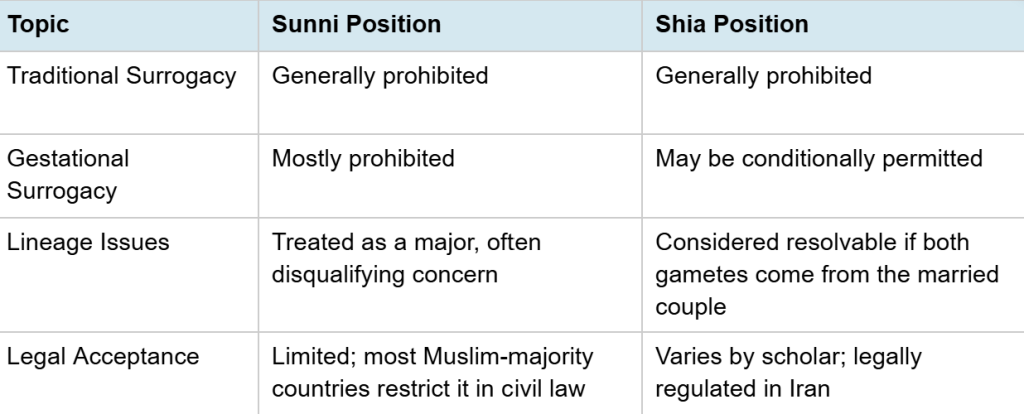
This kind of Islamic ruling on surrogacy sunni shia comparison surfaces in most academic treatments of the subject[3], though it is worth remembering that “Sunni” and “Shia” each cover a range of schools and individual jurists rather than one voice.
Why Is Surrogacy Considered Haram by Many Scholars?
Even setting the Sunni/Shia divide aside, four recurring concerns explain why surrogacy is haram in the more common conclusion across Islamic scholarship as a whole.
Preservation of Lineage (Nasab)
Some Sunni scholars and jurists who do not accept the use of surrogacy cite passages from the Qur’an which states that the sexual and reproductive life of believers is only permitted within a couple, and the hadith from the Prophet Muhammed (SAW), from Ruwayfi’ ibn Thabit, where a man was told that he must not place his seed within a woman to whom it does not belong (interpreted by scholars as forbidding the insemination of a woman who is not his wife).2] They argue that placing a fertilized embryo into a woman who is not the woman’s husband constitutes the same offense without any sexual activity; the problem they identified remains, the identity of a child’s parent is unknown. This is the most commonly given response as to why surrogacy is haram in Sunni scholarship.
Questions of Motherhood
Another area that complicates jurisprudence in the most challenging way possible involves gestational surrogacy-that is, when one woman carries to term a baby conceived from another woman’s egg. The jurists who champion the genetic mother cite verses describing human generation from a seed, arguing that descent is determined by the genetic origin of human life rather than by the womb that hosted its gestation, thus treating the surrogate more like a nurse than a mother. Still other scholars look at a verse of the Quran describing an individual’s mothers as “they that gave them birth” and thus argue that a birthmother is the legal mother, no matter how the conception occurred [2].
Inheritance and Family Rights
There is a well-defined, fixed set of proportional share interests based on specified family relationships, so the unresolved question of the true legal mother can have real downstream implications for a child’s inheritance, custody, and guardianship. The best way, as one academic has put it, to try and close a gap in the law found in some Arab family codes: Genetic “fingerprinting”… [a] “quick, inexpensive and effective method to attach a child to the correct biological parents whosegametes were responsible for that child’s creation regardless of any particular judge’s decision or scholarly debate about the morality and practice. [1][2].
Marriage Boundaries and Reproductive Ethics
More widely, there are also several scholars who have the broader ethical objection that a woman’s uterus becomes rentable or payable, and with that, the idea of conception and parenthood would become a matter of purchase and sale, a commercialization of the process outside of its natural purpose in marriage [2][5]. The fears of Exploitation of women suffering financial hardship; the issue of the surrogate feeling attached to the child she is bearing, and issues of contract; there has indeed been a notable case in which a paid surrogate in the UK initially refused to give up the baby which she was carrying in 1985. However, these objections have been framed less around the medicine and the process itself than around the fact that market principles are being injected into procreation and the effect it has on family ethics. [2]
Ethical and Legal Issues of Surrogacy in Islamic Law
Even scholars who are open to surrogacy under strict conditions acknowledge a set of practical issues that any Islamic legal framework has to resolve.
The Parentage problem has been identified in the intro: whether or not the genetic mother or the birth mother becomes the mother in legal eyes will drive all of the following issues. Issues of guardianship (wilayah) between the surrogate and the intending parents will occur if there is any difficulty at the time of delivery. Surrogates who do not want to give up the baby following birth do exist. Questions of succession are dependent on a decided question of fact in terms of who the parents are and on what basis it is decided that someone is a parent for this purpose – this cannot be a general intention, as inheritance involves specific people and specific relationship names. [2].
The rights of the surrogate mother are also a relevant issue. Contemporary writings on surrogate motherhood in Islamic law cover many questions related to appropriate compensation ( whether to characterize it as compensation for the risks of medical procedures and care instead of a fee for her body’s utilization), issues regarding informed consent, and the level of medical care she should receive during pregnancy. Among concerns relating to child welfare is the potential emotional harm stemming from potential ownership or “attachment” conflicts between the surrogate and the intended parents, as well as concerns about the commodification of reproduction with likely adverse effects on financially disadvantaged women.[2]
The legislation that has been put in place by many of the Arab countries with legislation on surrogacy, such as Algeria, Libya, Tunisia, Saudi Arabia, the UAE, and Bahrain, predominantly bans commercial or gestational surrogacy under civil law. A number of those states impose criminal liability on parties involved in surrogacy arrangements[2]. Iran is unique among Arab/Muslim Majority countries in that civil law is aligned with the religious jurisprudence of the Shia school of law, which allows gestational surrogacy subject to guidelines. It serves as an internal frame of reference for this debate, and we look more closely into the Iranian regulatory model in a guide of its own on surrogacy in Iran.[2][3]