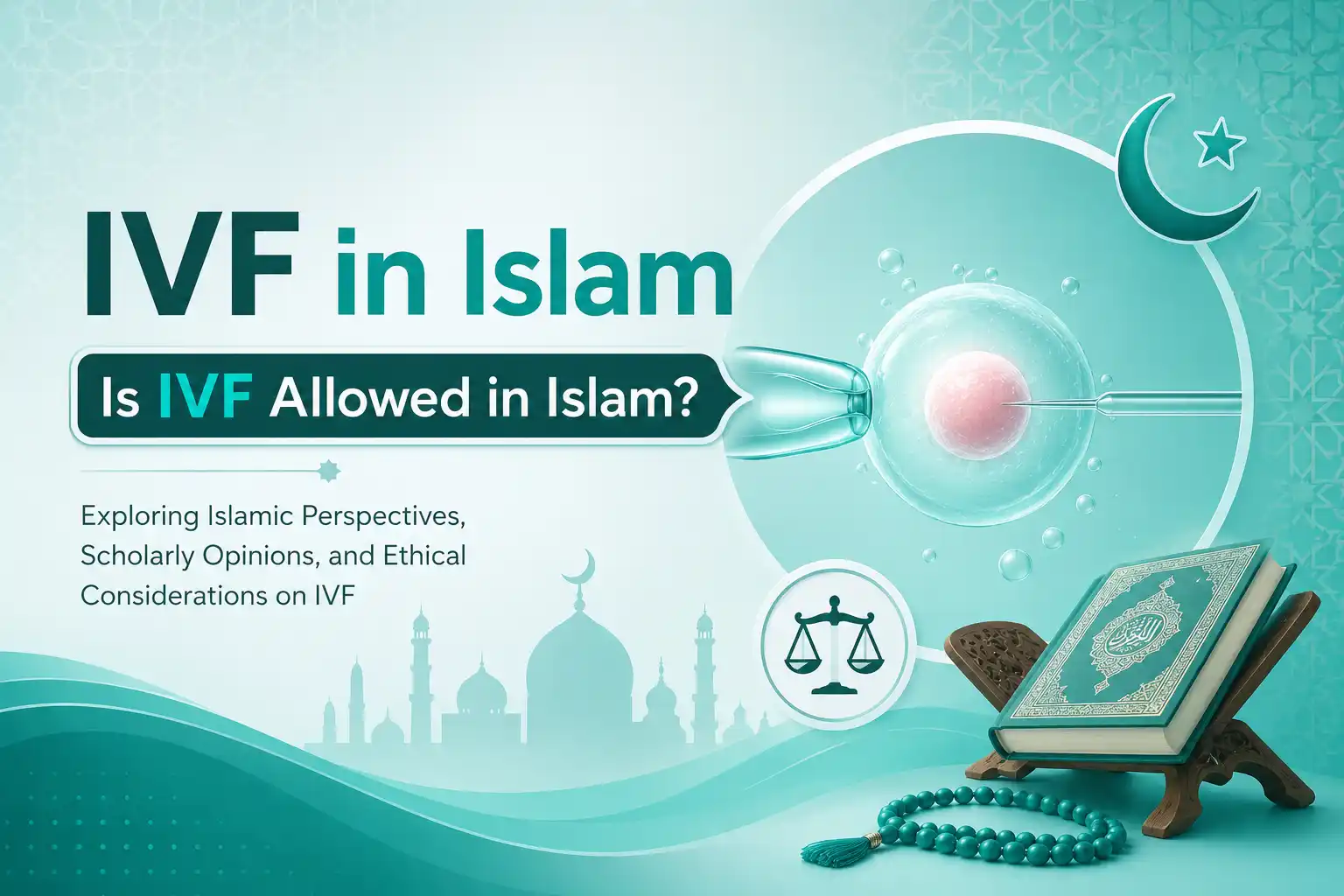
If you’re asking Is IVF in Islam permitted? Here’s the direct answer before anything else: most Islamic scholars across both major schools agree that IVF is permissible in principle, but only under specific conditions, and those conditions are exactly where Sunni and Shia jurisprudence part ways. There is no single, universal ruling that applies to every case, which is why this deserves a careful answer rather than a quick yes or no.
IHA walks through this the way I’d want a knowledgeable, honest source to: covering what the major schools of thought actually say, where they agree, where they diverge, and what that means practically for a Muslim couple considering treatment.
Understanding IVF (In Vitro Fertilization)
IVF is a fertility treatment where an egg is fertilized by sperm outside the body, in a laboratory, and the resulting embryo is transferred into the uterus. This differs from artificial insemination (IUI), where sperm is placed directly into the uterus and fertilization still happens inside the body. According to the World Health Organization’s definitions of assisted reproductive technology, both fall under the broader category of assisted reproduction, but IVF involves an additional lab-based step that raises distinct jurisprudential questions about what happens to eggs, sperm, and embryos outside the body.
Couples turn to IVF for reasons including blocked fallopian tubes, low sperm count, unexplained infertility, or after other treatments like IUI haven’t succeeded. The American Society for Reproductive Medicine (ASRM) notes that IVF remains one of the most effective treatments available for a wide range of infertility causes, which is part of why this question comes up so often for Muslim couples weighing their options.
What Does Islam Say About IVF?
General Islamic Principles
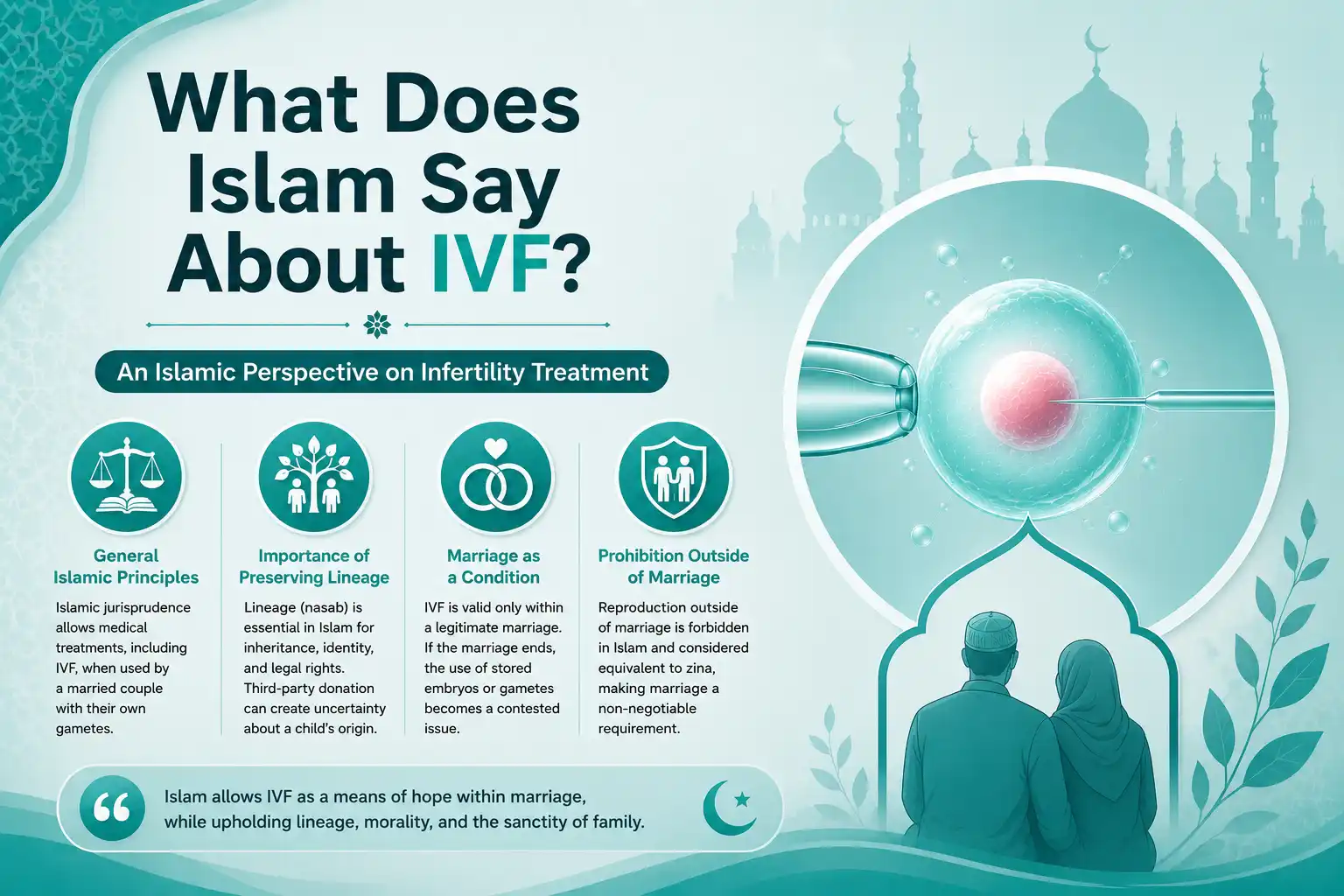
Islamic jurisprudence doesn’t treat medical technology as inherently forbidden. The guiding principle across nearly all schools of thought is that infertility treatment is permissible when it helps a married couple conceive using their own gametes, and becomes questionable specifically when it introduces a third party into the reproductive process. As early as 1980, Egypt’s Al-Azhar University, one of Sunni Islam’s most authoritative institutions, issued a foundational fatwa stating that IVF and similar technologies are permissible as long as they involve only the married couple, with no donor sperm, eggs, embryos, or surrogate uterus involved.
Importance of Preserving Lineage
Lineage, or nasab, holds significant weight in Islamic law, since it determines inheritance rights, family identity, and legal responsibility. Many Islamic scholars link the restriction on third-party donation directly to this concern: introducing genetic material from outside the marriage creates ambiguity about a child’s biological origin, which Islamic inheritance and family law is generally structured to avoid. This is a recurring theme across both Sunni and Shia positions, even where they disagree on other details.
Marriage as a Condition
Nearly every scholarly opinion on this topic agrees on one point: IVF is only considered valid within the context of a legitimate marriage. If a couple separates or one spouse passes away, the continued use of stored embryos or gametes becomes a separate and contested question, since the marital relationship that justified the treatment in the first place no longer exists. Reproduction outside of marriage is considered analogous to zina in Islamic teaching, according to the Al-Azhar fatwa framework, which is part of why marital status is treated as a non-negotiable starting point rather than a minor detail.
When Is IVF Considered Halal?
According to many Sunni scholars, along with the broad consensus among Shia jurists on this specific point, IVF is generally considered permissible when all of the following conditions are met:
- The sperm belongs to the husband
- The eggs belong to the wife
- The embryo is transferred during a valid, existing marriage
- No third-party involvement occurs at any stage: no donor gametes, no donor embryo, no surrogate
Several Islamic scholars and bodies, including the International Islamic Fiqh Academy, have issued formal rulings affirming that IVF meeting these conditions is halal, provided the procedures are performed by qualified medical professionals and embryos are handled with appropriate respect and care.
When Is IVF Considered Haram?
The picture changes considerably once a third party enters the process. According to many Sunni scholars, the following scenarios are generally considered haram:
- Donor sperm from a man who is not the husband
- Donor eggs from a woman who is not the wife
- Surrogacy, where a woman other than the wife carries the pregnancy
- Mixing embryos from different couples, or any process that creates ambiguity about genetic parentage
The reasoning cited most often is that introducing outside genetic material resembles the concerns Islamic law raises around zina and lineage confusion, even without any physical impropriety involved. As detailed in a peer-reviewed anthropological study on IVF and gamete donation in Sunni and Shia Islam, this concern about lineage not the technology itself is the central objection driving these restrictions in Sunni jurisprudence specifically.
Sunni and Shia Perspectives
This is the area where Islamic scholarship genuinely diverges, and it’s worth understanding both positions rather than treating one as universally authoritative.
The Sunni position is comparatively unified. According to many Sunni scholars, third-party involvement in any form, such as donor sperm, donor eggs, embryo donation, or surrogacy, is prohibited, regardless of the circumstances or medical necessity involved. This view has been reaffirmed by multiple modern Sunni fiqh councils since the original Al-Azhar ruling, and remains the dominant position across most Sunni-majority countries today.
The Shia position is considerably more varied, largely because Shia jurisprudence relies heavily on ijtihad, independent juristic reasoning by qualified scholars rather than only scriptural precedent. This has produced a genuine range of views among senior Shia authorities:
- Ayatollah Khamenei permits IVF between a married couple and has issued a fatwa permitting gestational surrogacy specifically when the embryo is created from the couple’s own gametes, according to a detailed review of Shia fatwas on assisted reproduction.
- Ayatollah Sistani permits IVF within marriage and has stated that surrogacy is permissible in principle when the sperm and egg belong to a legally married couple and the resulting embryo is carried by another woman, though questions of legal maternity still require separate resolution.
- Some Shia jurists, including Ayatollah Nouri Hamedani and Ayatollah Vahid Khorasani, cautiously permit egg donation but stress the need for strict legal safeguards to protect the resulting child’s rights and identity.
- Other prominent Shia authorities, including Shaikh Muhammad Husayn Fadlallah of Lebanon, disagree with the more permissive rulings and align closer to the restrictive Sunni position on gamete donation, according to the NCBI Bookshelf review of Islamic perspectives on assisted reproduction.
This divide has had real practical consequences. Iran, a Shia-majority country, became one of the first Muslim-majority nations to formally legislate and regulate egg donation, embryo donation, and gestational surrogacy in Islam, building licensed clinical frameworks around Khamenei’s fatwa. Many Sunni-majority countries, by contrast, prohibit these same procedures outright, in line with the original Al-Azhar position. Even within Shia scholarship, however, the NCBI Bookshelf review notes that a meaningful number of Shia authorities side with the majority Sunni view and reject third-party gamete donation entirely so Shia and permissive are not interchangeable, and any individual considering treatment should confirm the specific position of the scholar or school they follow.
For couples specifically considering treatment options that involve donor gametes or a gestational carrier, understanding the legal and religious framework of the destination country matters as much as the general jurisprudential debate for example, IVF in Iran operates under one of the more clearly regulated frameworks among Muslim-majority nations for exactly this reason.
A Note on Embryo Freezing
Embryo freezing itself is generally treated as permissible by most scholars across both schools, since it doesn’t inherently involve third-party donation; it simply preserves the couple’s own genetic material for future use within the same marriage. The more contested question is what happens to frozen embryos if the marriage ends through divorce or death, since the original justification for creating them (a valid, ongoing marriage) no longer applies. Scholars have not reached uniform agreement on this specific scenario, and it’s frequently cited as one of the more unresolved areas of modern Islamic bioethics.

Frequently Asked Questions
Is IVF halal?
IVF is generally considered halal by many scholars when it uses only the husband’s sperm and the wife’s eggs, within a valid marriage, with no third-party donor involved.
Is IVF haram?
IVF becomes haram in the view of most Sunni scholars and some Shia jurists when it involves donor sperm, donor eggs, donor embryos, or a surrogate who is not the wife.
Is artificial insemination allowed in Islam?
Artificial insemination (IUI) follows the same core principle as IVF: permissible within marriage using the husband’s and wife’s own gametes, and generally viewed as impermissible when donor sperm is involved, according to the same scholarly consensus that applies to IVF.
Can Muslims use donor sperm?
According to many Sunni scholars, no. Some Shia jurists, including Ayatollah Khamenei in his original fatwa, have permitted it under specific conditions, though other Shia authorities disagree, making this one of the most divided questions in the field.
Can Muslims use donor eggs?
This divides scholars more than almost any other question in reproductive medicine. Several Sunni bodies prohibit it outright, while some Shia jurists permit it under strict conditions intended to protect the child’s legal identity and inheritance rights.
Is surrogacy allowed in Islam?
Most Sunni scholars consider surrogacy impermissible due to third-party involvement. Some Shia authorities, particularly prominent Iranian religious leaders, permit gestational surrogacy when the embryo comes from a legally married couple’s own gametes.
Is embryo freezing permissible?
Generally yes, for embryos created from a couple’s own gametes during a valid marriage. What happens to those embryos after divorce or death remains a genuinely unresolved question among scholars.
What do Islamic scholars say about IVF overall?
There is broad agreement that IVF is permissible within marriage using a couple’s own gametes. Beyond that baseline, opinions diverge significantly, particularly between Sunni consensus against any third-party donation and the more varied Shia positions that sometimes permit it under defined conditions.

So, is IVF in Islam allowed? In its most basic form, a married couple using their own sperm and eggs, the answer from the overwhelming majority of Islamic scholars, both Sunni and Shia, is yes. Once donor gametes, embryo donation, or surrogacy enter the picture, the answer becomes genuinely dependent on which school of thought and which specific scholar a couple follows, with real, documented disagreement even within Shia jurisprudence itself.
This isn’t a question this article, or any single source, can resolve on your behalf. If you’re a Muslim couple considering IVF, the most responsible path is a two-track conversation: one with a qualified reproductive endocrinologist about your specific medical situation, and one with a knowledgeable religious scholar from your own tradition about which options align with your beliefs. Neither conversation substitutes for the other.
Sources
- World Health Organization, “Infertility” https://www.who.int/news-room/fact-sheets/detail/infertility
- American Society for Reproductive Medicine https://www.asrm.org
- PMC, “Making Muslim Babies: IVF and Gamete Donation in Sunni versus Shi’a Islam” https://pmc.ncbi.nlm.nih.gov/articles/PMC1705533/
- NCBI Bookshelf, “Assisted Reproductive Technology: Islamic Perspective” https://www.ncbi.nlm.nih.gov/books/NBK500175/
- American Surrogacy, “Muslims and IVF: Your Options as an Islamic Family”https://www.americansurrogacy.com/parents/muslims-and-IVF
- Samrudh Fertility and Urology, “Understanding the Islamic Perspective on In Vitro Fertilization” — https://samrudhfertilityurology.com/blog/understanding-the-islamic-perspective-on-in-vitro-fertilization/