
- Advantages of surrogacy: Offers a path to parenthood, a possible genetic connection, and an alternative when pregnancy is medically unsafe or impossible.
- Disadvantages of surrogacy: High costs, emotional stress, medical complications, legal challenges, and no guaranteed pregnancy.
- Medical risks: IVF complications, miscarriage, premature birth, gestational diabetes, and other pregnancy-related health risks.
- Surrogacy in Iran: Access to fertility clinics and potentially lower treatment costs than in some countries, but legal and documentation challenges remain.
- Cost and success rates: Expenses depend on IVF, surrogate-related costs, medical care, and legal services. Success depends on embryo quality and individual medical factors.
- Is surrogacy worth it? It can be a valuable family-building option, but intended parents should assess medical suitability, finances, legal parenthood, and ethical considerations.
What Is Surrogacy?
Surrogacy is an arrangement in which a woman, known as a surrogate or gestational carrier, carries a pregnancy for another person or couple, called the intended parents.
It offers a family-building option for people who cannot carry a pregnancy or for whom pregnancy presents significant medical risks.
There are two main types of surrogacy: gestational surrogacy and traditional surrogacy.
Costs and legal risk vary widely by country, and surrogacy in Iran is usually presented as the affordable option.
Gestational Surrogacy
Gestational surrogacy involves transferring an embryo created through in vitro fertilization (IVF) into the uterus of a gestational carrier.
The embryo may be created using:
- Eggs and sperm from both intended parents.
- An intended parent’s egg or sperm combined with donor reproductive material.
- Donor eggs and donor sperm, where legally and medically permitted.
The gestational carrier has no genetic relationship to the child.
Gestational surrogacy is commonly used in medically assisted surrogacy programs. However, legal parenthood must still be established according to applicable laws.
Traditional Surrogacy
In traditional surrogacy, the surrogate’s own egg is used to conceive the child.
As a result, the surrogate is genetically related to the baby.
Traditional surrogacy may involve additional emotional, ethical, and legal complications. Its availability also varies between countries.

Surrogacy Pros and Cons at a Glance
Understanding the advantages and disadvantages of surrogacy helps intended parents evaluate whether it is the right family-building option.
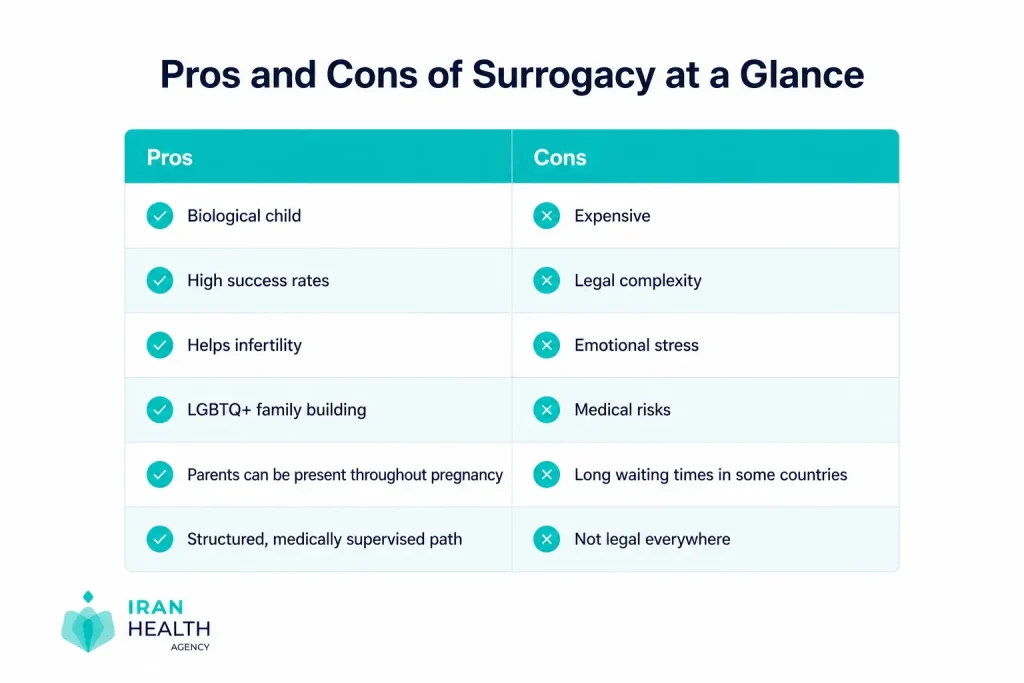
| Advantages of Surrogacy | Disadvantages of Surrogacy |
|---|---|
| May allow a genetic connection to the child. | Can involve substantial expenses. |
| Provides an option when pregnancy is medically unsafe. | Involves IVF and pregnancy-related medical risks. |
| Helps overcome certain barriers to parenthood. | Pregnancy and live birth are not guaranteed. |
| Allows involvement in the pregnancy journey. | Can create emotional challenges. |
| Offers a planned family-building arrangement. | Requires complex legal agreements. |
| May provide access to fertility treatment abroad. | International documentation can be complicated. |
| Creates additional family-building opportunities. | Raises ethical and financial concerns. |
The importance of each benefit and disadvantage depends on the intended parents’ medical needs, financial circumstances, personal values, and country of residence.

7 Advantages of Surrogacy
The benefits of surrogacy extend beyond the possibility of having a child. For eligible intended parents, it can provide a carefully planned route to building a family.
1. Possibility of Having a Biological Child
One of the biggest advantages of gestational surrogacy is the possibility of having a child genetically related to one or both intended parents.
When embryos are created using the intended parents’ eggs and sperm, another woman can carry the pregnancy without changing the child’s genetic origins.
However, a genetic connection depends on whose eggs and sperm are used. Donor-assisted arrangements may result in different genetic relationships.
2. An Option When Pregnancy Is Medically Unsafe
Some individuals cannot safely carry a pregnancy because of medical conditions or reproductive health problems.
Surrogacy may be considered in situations involving:
- Absence of the uterus.
- Significant uterine abnormalities.
- Medical conditions that make pregnancy dangerous.
- Certain cases of recurrent pregnancy loss associated with uterine factors.
- Selected cases of repeated embryo transfer failure after specialist assessment.
The American Society for Reproductive Medicine recognizes gestational carriers as an option for certain medical and biological indications.
A qualified fertility specialist should determine whether surrogacy is medically appropriate.
3. Another Option After Fertility Treatment Challenges
Some intended parents consider surrogacy following unsuccessful fertility treatments.
When the primary problem involves carrying a pregnancy rather than creating viable embryos, gestational surrogacy may provide another treatment option.
However, surrogacy does not resolve every cause of infertility.
Factors such as egg quality, sperm quality, embryo development, and genetic conditions may still affect the outcome.
Repeated IVF failure does not automatically mean surrogacy will improve the chance of having a baby.
4. Opportunity to Participate in the Pregnancy Journey
Surrogacy may allow intended parents to participate in important stages of pregnancy.
Depending on the arrangement and the gestational carrier’s preferences, this may include:
- Receiving pregnancy updates.
- Attending agreed medical appointments.
- Following important pregnancy milestones.
- Preparing for the baby’s arrival.
- Building a respectful relationship with the gestational carrier.
Participation must respect the carrier’s privacy, informed consent, and medical decision-making rights.
5. More Family-Building Opportunities
Surrogacy offers another possible path to parenthood when carrying a pregnancy is not feasible.
It can be considered alongside other options, including donor-assisted fertility treatment and adoption.
However, legal eligibility differs between countries. Not every family structure or surrogacy arrangement is permitted in every jurisdiction.
International intended parents should verify their eligibility before beginning treatment.
6. A Carefully Planned Reproductive Process
A properly managed gestational surrogacy arrangement can involve medical screening, psychological counseling, informed consent, legal preparation, and written agreements.
These steps help clarify expectations and responsibilities.
Important arrangements may address:
- Medical examinations and treatment.
- Pregnancy monitoring.
- Financial responsibilities.
- Insurance coverage.
- Communication between the parties.
- Medical complications and emergencies.
- Birth registration and legal parenthood.
Although careful preparation can reduce uncertainty, no agreement can eliminate all risks.
7. Access to International Fertility Treatment Options
Some intended parents investigate surrogacy abroad because of differences in treatment availability, healthcare costs, or legal restrictions.
Iran is one country where fertility clinics provide assisted reproductive services, including IVF and gestational surrogacy.
Potential benefits of researching treatment in Iran include:
- Access to established fertility treatment centers.
- Availability of IVF and related reproductive services.
- Potentially lower medical expenses than in some higher-cost countries.
- Access to treatment coordination and translation services through some providers.
However, medical service availability does not automatically establish legal eligibility or guarantee parentage, citizenship, or travel documentation.
International patients must investigate these matters before making treatment commitments.

7 Disadvantages of Surrogacy
Despite its potential benefits, surrogacy involves medical, financial, emotional, and legal challenges. Understanding these disadvantages is essential before starting the process.
1. High Surrogacy Costs
One of the main disadvantages of surrogacy is its financial cost.
The total expense may include:
- Medical consultations and fertility testing.
- IVF medications and laboratory procedures.
- Egg retrieval and embryo transfer.
- Gestational carrier screening.
- Surrogate-related compensation or reimbursements.
- Prenatal care and childbirth.
- Legal agreements and documentation.
- Insurance and emergency treatment.
- Travel, accommodation, and translation.
- Additional embryo transfers if treatment is unsuccessful.
Costs vary considerably by country, clinic, treatment plan, and individual circumstances.
Intended parents should obtain a detailed written estimate that identifies included services, exclusions, and possible additional expenses.
2. Medical Risks for the Surrogate and Intended Parents
Surrogacy involves medical procedures and pregnancy-related health risks.
The egg provider may experience complications related to ovarian stimulation or egg retrieval.
The gestational carrier faces the normal medical risks associated with pregnancy and childbirth, including:
- Miscarriage.
- Gestational diabetes.
- High blood pressure and preeclampsia.
- Ectopic pregnancy.
- Premature delivery.
- Cesarean delivery.
- Postpartum complications.
The likelihood and severity of complications vary between individuals.
Comprehensive screening and appropriate prenatal care are essential, but they cannot eliminate every risk.
3. No Guaranteed Pregnancy or Live Birth
Surrogacy does not guarantee a successful pregnancy or a healthy baby.
Even when a medically screened carrier and suitable embryos are available, embryo transfer may fail.
Success can depend on:
- Age of the egg provider.
- Embryo quality.
- Reproductive health history.
- Fertility laboratory practices.
- Medical factors affecting implantation and pregnancy.
Intended parents should request reliable, clinic-specific outcome information for patients with similar circumstances.
Be cautious of programs advertising guaranteed success or unusually high success rates without supporting evidence.
4. Emotional and Psychological Challenges
Surrogacy can be emotionally demanding for intended parents and gestational carriers.
Potential challenges include:
- Anxiety about treatment results.
- Fear of pregnancy complications.
- Disappointment after an unsuccessful embryo transfer.
- Uncertainty about legal procedures.
- Stress related to financial commitments.
- Different expectations between the parties.
Psychological counseling and clear communication can help participants prepare for these challenges.
The emotional wellbeing of the surrogate should receive the same serious consideration as that of the intended parents.
5. Complicated Legal Requirements
Legal uncertainty is one of the most significant disadvantages of surrogacy, particularly for international intended parents.
Surrogacy laws vary considerably between countries.
Important legal questions include:
- Who will be recognized as the child’s legal parents?
- Are surrogacy agreements enforceable?
- How will the child’s birth be registered?
- Will the home country recognize the parent-child relationship?
- How will the child obtain citizenship and travel documents?
A private surrogacy agreement does not automatically establish legal parenthood.
Independent legal advice should be obtained before any arrangement begins.
6. Uncertain Timelines and Possible Delays
The surrogacy process may involve medical assessments, surrogate matching, legal preparation, IVF, pregnancy, childbirth, and post-birth documentation.
Unexpected delays can arise from:
- Medical test results.
- Carrier availability.
- Unsuccessful embryo transfers.
- Pregnancy complications.
- Legal procedures.
- International travel and immigration requirements.
Intended parents should prepare for a potentially lengthy and unpredictable process.
7. Ethical Concerns and Surrogate Protection
Surrogacy raises important ethical questions regarding autonomy, informed consent, compensation, and the wellbeing of the gestational carrier and child.
Potential concerns include:
- Financial pressure on gestational carriers.
- Inadequate medical or psychological support.
- Unclear compensation agreements.
- Unequal bargaining power.
- Insufficient independent legal representation.
- Disagreements about pregnancy-related decisions.
Ethical surrogacy arrangements should prioritize voluntary participation, transparent financial terms, independent advice, appropriate healthcare, and protection from coercion.

Pros and Cons of Surrogacy at a Glance


Gestational vs. Traditional Surrogacy: Pros and Cons
Gestational and traditional surrogacy differ in their medical procedures, genetic relationships, and legal considerations.
| Factor | Gestational Surrogacy | Traditional Surrogacy |
|---|---|---|
| Surrogate genetically related to the child | No | Yes |
| IVF required | Yes | Not necessarily |
| Genetic connection to intended parents | Possible | Depends on sperm source |
| Medical procedures | IVF, embryo transfer, and pregnancy | Depends on conception method |
| Legal considerations | Significant | Potentially more complex |
| Availability | Depends on local laws | Often more restricted |
Gestational surrogacy is generally the more relevant option for intended parents considering medically assisted international surrogacy.
Surrogacy in Iran: Advantages and Disadvantages
Iran has established fertility treatment centers offering assisted reproductive technologies, including IVF and gestational surrogacy.
However, international intended parents must evaluate medical services separately from legal eligibility, parentage, and citizenship requirements.
Advantages of Surrogacy in Iran
1. Access to Fertility Treatment Centers
Iran has fertility clinics offering IVF and related reproductive services.
Intended parents may be able to access consultations, embryo creation, embryo transfer, and other fertility treatments.
The availability of specific services for foreign patients should be confirmed directly with the selected clinic.
2. Potentially Lower Treatment Costs
One reason some patients investigate surrogacy in Iran is the possibility of lower medical expenses compared with certain higher-cost destinations.
However, total costs depend on treatment requirements, surrogate-related expenses, legal services, accommodation, and travel.
Lower starting prices do not necessarily mean lower final costs.
3. Availability of Medical Coordination Services
Some healthcare facilitators assist international patients with treatment arrangements.
Depending on the provider, services may include:
- Organizing fertility consultations.
- Scheduling medical appointments.
- Translation and interpretation.
- Accommodation coordination.
- Assistance with treatment-related communication.
Patients should distinguish administrative coordination from licensed medical services and independent legal advice.
Disadvantages of Surrogacy in Iran
1. Incomplete Surrogacy Legal Framework
Iran does not have a comprehensive surrogacy statute addressing every aspect of domestic and international arrangements.
Although gestational surrogacy is practiced, important legal questions remain concerning contracts, parental rights, compensation, and dispute resolution.
Iran’s embryo donation legislation should not be confused with a comprehensive surrogacy law.
2. Legal Eligibility for Foreign Intended Parents
International intended parents should not assume that surrogacy services are available to every foreign individual or couple.
Eligibility may require examination of nationality, marital status, medical circumstances, and applicable legal requirements.
Independent legal advice is essential before entering an arrangement.
3. Birth Registration and Parentage Challenges
A child born through surrogacy in Iran may face complicated procedures for establishing legal parenthood and obtaining official documentation.
Legal recognition of intended parents should never be assumed solely because a private agreement exists.
4. Citizenship and International Travel
International intended parents must determine how the child will obtain nationality, a passport, and permission to travel.
Recognition of parentage in Iran does not guarantee equivalent recognition in the intended parents’ home country.
These requirements should be investigated before treatment begins.
5. Ethical and Financial Uncertainty
Incomplete regulations can create uncertainty about the rights and obligations of intended parents, medical providers, and gestational carriers.
Recent academic research has highlighted legal and ethical challenges related to surrogacy in Iran, especially international arrangements.
Is Surrogacy Legal in Iran?
Gestational surrogacy is practiced in Iran, but the legal framework is complex.
There is no comprehensive national surrogacy law clearly resolving every legal issue involving intended parents, gestational carriers, and children born through these arrangements.
Important considerations include:
- Legal eligibility of intended parents.
- Validity and enforceability of agreements.
- Rights and responsibilities of the gestational carrier.
- Recognition of legal parenthood.
- Birth registration requirements.
- Citizenship and travel documentation.
- Recognition of the arrangement in the home country.
Foreign intended parents should obtain written legal advice from qualified professionals in Iran and their country of residence.
Medical treatment availability does not guarantee that a proposed arrangement is legally feasible.
How Much Does Surrogacy Cost in Iran?
The cost of surrogacy in Iran varies depending on the fertility clinic, medical procedures, gestational carrier arrangements, and legal requirements.
A comprehensive cost estimate should include all major expenses rather than only the initial IVF treatment.
| Cost Category | Expenses to Consider |
|---|---|
| IVF treatment | Consultations, testing, medications, egg retrieval, fertilization, and embryo transfer. |
| Surrogate-related expenses | Medical screening, compensation or reimbursement, and agreed financial responsibilities. |
| Pregnancy care | Prenatal appointments, examinations, scans, tests, and delivery. |
| Legal services | Agreements, parentage procedures, birth registration, and documentation. |
| Travel and accommodation | Flights, visas, accommodation, transportation, and translation. |
| Additional expenses | Repeat embryo transfers, medical complications, neonatal care, and unexpected delays. |
Before selecting a program, intended parents should request:
- A written breakdown of all fees.
- Clear information about included and excluded services.
- Refund and cancellation terms.
- Costs of additional treatment attempts.
- Emergency medical expense arrangements.
- Legal service costs.
- Expected travel and accommodation expenses.
Surrogacy expenses should be evaluated alongside medical quality, ethical safeguards, and legal feasibility.
Medical Risks of Surrogacy for the Surrogate and Baby
Medical safety is an essential consideration for everyone involved in surrogacy.
Risks for the Gestational Carrier
Pregnancy can cause physical and psychological complications even when the carrier is medically healthy.
Potential risks include:
- Gestational diabetes.
- Pregnancy-related hypertension.
- Preeclampsia.
- Miscarriage.
- Preterm labor.
- Cesarean delivery.
- Postpartum complications.
- Emotional stress.
Appropriate screening, medical monitoring, and access to emergency obstetric care are important safeguards.
Risks for the Baby
Potential risks for the baby include premature birth, low birth weight, and complications related to multiple pregnancy.
Some risks are influenced by IVF treatment decisions, including the number of embryos transferred.
Medical guidance generally favors single-embryo transfer in gestational carrier arrangements to reduce the risks of multiple pregnancy.
How Can Surrogacy Risks Be Reduced?
Risk reduction measures include:
- Comprehensive medical screening.
- Psychological assessment and counseling.
- Infectious disease testing.
- Evidence-based IVF practices.
- Appropriate embryo transfer decisions.
- Regular prenatal monitoring.
- Independent informed consent.
- Emergency treatment planning.
- Clear financial and legal responsibilities.
These measures improve preparation but cannot guarantee a risk-free pregnancy.
Surrogacy vs. Adoption: Which Is Better?
Surrogacy and adoption are different family-building options. The better choice depends on personal circumstances, legal eligibility, financial resources, and family-building priorities.
| Factor | Surrogacy | Adoption |
|---|---|---|
| Genetic connection | May be possible. | Usually not present. |
| Pregnancy involvement | May be possible. | Generally not applicable. |
| Medical treatment | Required for gestational surrogacy. | Not required for adoptive parents. |
| Legal procedures | Often complex. | Often complex. |
| Financial costs | Can be substantial. | Vary by circumstances. |
| Timeline | Uncertain. | Uncertain. |
| International requirements | Parentage, nationality, and travel documentation. | Adoption and immigration requirements. |
Neither option is universally better. Intended parents should evaluate both with appropriate professional guidance.
Is Surrogacy Worth It?
Surrogacy may be worth considering when intended parents cannot carry a pregnancy and want to explore a genetically related or donor-assisted family-building option.
However, it is not suitable for everyone.
Before deciding, consider the following:
- Medical suitability: Has a fertility specialist evaluated your circumstances?
- Financial readiness: Can you afford treatment and unexpected costs?
- Legal feasibility: Can parenthood and documentation be established?
- Success expectations: Do you understand that treatment may fail?
- Surrogate wellbeing: Are appropriate protections and independent support available?
- Emotional readiness: Are you prepared for uncertainty and possible delays?
- International requirements: Can you legally return home with the child?
For international arrangements, legal feasibility should be confirmed before making substantial financial commitments.
How Does the Surrogacy Process in Iran Work?
The following steps illustrate a possible surrogacy planning process. Actual requirements vary according to medical circumstances, clinic procedures, and applicable laws.
Step 1: Medical Consultation
Intended parents consult a fertility specialist to review reproductive history, medical indications, available embryos, and treatment options.
Step 2: Legal Eligibility Assessment
Independent lawyers in Iran and the intended parents’ home country evaluate the proposed arrangement.
The assessment should address eligibility, parentage, birth registration, citizenship, and travel documentation.
Step 3: Clinic and Gestational Carrier Assessment
If the arrangement is medically and legally feasible, the clinic and relevant professionals evaluate the proposed gestational carrier’s health and suitability.
Informed consent and independent support are essential.
Step 4: Agreement and Financial Planning
The parties review written arrangements covering medical care, responsibilities, expenses, complications, and dispute resolution.
Independent legal representation is strongly recommended.
Step 5: IVF and Embryo Transfer
The medical team prepares embryos and performs embryo transfer when clinically appropriate.
An embryo transfer does not guarantee pregnancy.
Step 6: Pregnancy and Delivery
The gestational carrier receives ongoing prenatal care and delivers at an appropriate medical facility.
Step 7: Birth Registration and Documentation
The relevant parties complete applicable procedures for birth registration, parentage recognition, nationality, and travel documents.
International intended parents should not assume these procedures will be automatic or quick.
How to Choose a Surrogacy Clinic or Agency in Iran
Selecting a fertility clinic or surrogacy coordination provider requires careful research.
Before making a commitment, ask:
- Is the fertility clinic appropriately licensed?
- Who is responsible for IVF treatment and pregnancy care?
- How are gestational carriers medically screened?
- Is independent psychological counseling available?
- How are surrogate rights and informed consent protected?
- Are treatment success rates supported by verifiable data?
- What expenses are included in the quoted price?
- Who pays for pregnancy complications or additional treatment?
- Is independent legal advice available?
- How will birth registration and parentage be handled?
- What is the process for citizenship and travel documentation?
Be cautious of providers promising guaranteed pregnancy, automatic citizenship, or effortless legal parenthood.
Frequently Asked Questions About Surrogacy
What are the main pros and cons of surrogacy?
The main advantages are the possibility of genetic parenthood, another option when pregnancy is medically unsafe, and participation in the pregnancy journey. The main disadvantages are high costs, medical risks, emotional challenges, legal complexity, and uncertain outcomes.
What is the biggest disadvantage of surrogacy?
The biggest disadvantage depends on individual circumstances. High costs, medical complications, and legal uncertainty are major concerns. For international intended parents, establishing parentage and obtaining documents for the child can be especially challenging.
Is surrogacy safe for the surrogate mother?
Many gestational carriers experience uncomplicated pregnancies, but pregnancy and childbirth always involve medical risks. Careful screening, prenatal monitoring, informed consent, and appropriate medical facilities help reduce these risks.
Can surrogacy fail?
Yes. IVF and embryo transfer do not guarantee pregnancy or live birth. Treatment success depends on embryo quality, reproductive factors, and individual medical circumstances.
Is surrogacy legal in Iran for foreigners?
Gestational surrogacy is practiced in Iran, but the country lacks a comprehensive statutory framework clearly resolving every international arrangement. Foreign intended parents need individualized legal advice concerning eligibility, parentage, birth registration, and travel documentation.
Can unmarried people or same-sex couples pursue surrogacy in Iran?
Eligibility cannot be assumed. Iran’s legal framework and family-law requirements differ from those of many other countries. Individuals and couples should obtain qualified Iranian legal advice before planning treatment or making payments.
Is surrogacy cheaper in Iran?
Some fertility treatment and related expenses may be lower in Iran than in certain higher-cost countries. However, total costs depend on IVF, surrogate-related expenses, medical care, legal services, travel, and unexpected complications.
How long does surrogacy in Iran take?
There is no universal timeline. The duration depends on medical preparation, legal assessment, gestational carrier availability, IVF success, pregnancy, and post-birth documentation.
Can intended parents take their baby home after surrogacy in Iran?
This depends on legal parentage, nationality, birth registration, passport eligibility, and immigration requirements. Intended parents should confirm the necessary procedures with independent lawyers and relevant government authorities before treatment.
Is gestational surrogacy better than traditional surrogacy?
Gestational surrogacy avoids a genetic relationship between the carrier and the child, which may simplify some aspects of the arrangement. However, both types involve medical, emotional, ethical, and legal considerations.
Can surrogacy guarantee a biological child?
No. Surrogacy does not guarantee pregnancy, live birth, or a genetic relationship. The outcome depends on treatment success and the eggs and sperm used to create the embryo.
What are the risks of international surrogacy?
Important risks include medical complications, financial uncertainty, differences between national laws, difficulties establishing parentage, and delays obtaining citizenship or travel documents for the child.
What should I check before choosing surrogacy in Iran?
Verify clinic credentials, medical screening procedures, total costs, legal eligibility, gestational carrier protections, parentage requirements, and the child’s nationality and travel arrangements.
Final Thoughts: Are the Benefits of Surrogacy Worth the Risks?
Understanding the pros and cons of surrogacy helps intended parents make informed decisions about their family-building options.
Surrogacy may offer a meaningful opportunity for people who cannot carry a pregnancy. However, it also involves medical risks, financial commitments, emotional challenges, and complex legal responsibilities.
For international patients considering surrogacy in Iran, the most important priorities are:
- Confirming medical suitability.
- Understanding realistic success rates.
- Obtaining a complete cost estimate.
- Protecting the gestational carrier’s rights.
- Confirming legal eligibility and parentage.
- Planning citizenship and travel documentation.
Medical quality, ethical safeguards, and legal feasibility should take priority over advertised prices.
Considering Surrogacy in Iran?
Iran Health Agency provides information about fertility treatment options and medical care coordination in Iran.
Contact our team to learn more about available services, treatment planning, and questions to discuss with medical and legal professionals.
Before committing to any program, independently verify the clinic’s credentials, request a detailed written cost estimate, and obtain specialist legal advice in Iran and your country of residence.
Medical and Research References
- American Society for Reproductive Medicine. Recommendations for Practices Using Gestational Carriers: A Committee Opinion. 2022. https://www.asrm.org/practice-guidance/practice-committee-documents/recommendations-for-practices-using-gestational-carriers-a-committee-opinion-2022/
- Human Fertilisation and Embryology Authority. Surrogacy: A Factsheet. https://www.hfea.gov.uk/about-us/media-centre/surrogacy-a-factsheet
- Haddadi M, et al. Challenges and Prospects for Surrogacy in Iran as a Pioneer Islamic Country in This Field. Archives of Iranian Medicine. 2025. https://pmc.ncbi.nlm.nih.gov/articles/PMC12085801/
- Modabber M, et al. Ghost Mothers: Ethical Challenges in Iran as an Emerging Destination for Cross-Border Surrogacy: A Case Report. International Journal of Reproductive BioMedicine. 2026. https://pubmed.ncbi.nlm.nih.gov/42051961/
Medical and Legal Disclaimer: This article provides general educational information and does not replace individualized medical or legal advice. Treatment availability, regulations, and documentation requirements may change. Intended parents should consult qualified medical specialists and independent legal professionals before making decisions.