

Surrogacy has helped thousands of families have children who otherwise might not have been able to. Like every fertility treatment, it offers real benefits, but it also comes with real challenges, financial, legal, medical, and emotional. Understanding both sides of the pros and cons of surrogacy is what actually helps intended parents make an informed decision, rather than one based on hope alone or fear alone.
This isn’t a simple pro-versus-con scorecard where one side automatically wins. A path that’s clearly right for one family, say, a couple who have tried IVF for years without success, might be entirely wrong for another family with different medical, financial, or legal circumstances. According to the American Society for Reproductive Medicine (ASRM), gestational surrogacy is now a well-established, medically regulated option, but ASRM guidelines also stress that it requires careful screening, legal counsel, and realistic expectations before beginning.
In this guide, we’ll walk through the genuine surrogacy pros and cons, not a sales pitch, and not a scare piece, so you can weigh them against your own situation. We’ll also touch on how surrogacy laws differ dramatically from one country to the next, because that legal variation affects nearly every other factor on this list, from cost to timeline to who is even eligible to pursue it.
What Is Surrogacy?
Surrogacy is an arrangement where a woman carries and delivers a baby for another person or couple, known as the intended parents. There are two main forms.
Traditional surrogacy uses the surrogate’s own egg, fertilized with the intended father’s or a donor’s sperm, usually via IUI. This makes the surrogate the biological mother of the child, which creates real legal and emotional complexity.
Gestational surrogacy uses an embryo created via IVF from the intended parents’ egg and sperm, or from donors, with no genetic link to the surrogate at all. This is now the dominant form of surrogacy worldwide, representing more than 95% of arrangements, according to recent surrogacy industry data, largely because it avoids the legal disputes over parentage that traditional surrogacy can create, since the surrogate has no biological claim to the child. For a full breakdown of how these arrangements differ, see our guide on types of surrogacy.
Pros of Surrogacy
Here are some advantages of surrogacy:
Allows People to Have a Biological Child
For couples facing infertility, surrogacy paired with IVF often means the baby still carries a genetic connection to one or both intended parents. This genetic link matters deeply to many people, and it’s one of the biggest reasons surrogacy is chosen over adoption.
A Safe Option for Women Unable to Carry a Pregnancy
Some women can produce healthy eggs but cannot safely carry a pregnancy due to recurrent miscarriage, the absence of a uterus, or a serious medical condition like heart disease or a history of dangerous pregnancy complications. Surrogacy allows them to still have a biological child without risking their own health.
Helps LGBTQ+ Families Become Parents
Gestational surrogacy is one of the primary paths to biological parenthood for gay male couples and other LGBTQ+ intended parents. Recent industry data shows 85% of gay male couples pursuing parenthood through surrogacy now choose the gestational route specifically.
Provides Hope After Repeated IVF Failure
For couples who’ve been through multiple failed IVF cycles, a gestational carrier can change the outlook entirely. A 2024 JAMA Network Open systematic review and meta-analysis found gestational carrier pregnancies often had equal or better live birth and perinatal outcomes compared with standard IVF pregnancies, largely because surrogates are carefully screened and are already known to have healthy, proven uteruses.
High Success Rates with Modern IVF
Success rates vary by embryo quality and clinic, but PGT-tested embryos transferred to a screened gestational carrier commonly achieve 70–80% live birth rates per transfer, according to 2026 data compiled from SART, notably higher than standard IVF rates without genetic screening.
Parents Can Participate Throughout Pregnancy
Unlike adoption, surrogacy typically allows intended parents to be involved from the very start, attending appointments, being present at the birth, and bonding with the pregnancy as it progresses, which many describe as an important part of the emotional experience of becoming a parent.
Cons of Surrogacy
High Overall Cost
Surrogacy is genuinely expensive. Costs vary enormously by country and program structure, covering medical care, agency coordination, legal fees, and compensation for the surrogate herself. This is consistently one of the biggest barriers intended parents face, and it’s worth getting a fully itemized quote before committing to any program, since headline numbers rarely include all the costs that come up along the way.
Complex Legal Requirements
Surrogacy law is not remotely consistent from one country to the next or even from one US state to the next. Some places recognize intended parents on the birth certificate automatically; others require lengthy court processes, and some ban commercial surrogacy outright. This is exactly why understanding where surrogacy is legal before starting the process matters as much as the medical planning.
Emotional Challenges
For the surrogate, carrying a pregnancy for someone else and then relinquishing the baby can bring complicated feelings, even in altruistic, well-supported arrangements. For intended parents, the process often involves a long emotional journey shaped by prior infertility, financial pressure, and simply not being the one physically carrying the pregnancy. Neither experience should be minimized.
Medical Risks
IVF stimulation and retrieval carry standard fertility treatment risks for the egg provider. Pregnancy complications, including preterm birth, which one study of 836 gestational carriers found occurred in about 15.1% of surrogacy pregnancies, largely tied to multiple pregnancies from transferring more than one embryo, remain a real consideration. Choosing single embryo transfer measurably lowers this risk, according to the same research.
Long Waiting Time
In some countries and programs, matching with a suitable surrogate alone can take anywhere from a few weeks to many months, and a full journey from initial consultation to birth commonly spans 12 to 18 months. Waiting times vary significantly depending on the country, agency, and specific medical circumstances involved.
Not Legal Everywhere
Surrogacy laws differ enormously by country, and in some places, commercial surrogacy is banned entirely or restricted to citizens only. This makes it essential to research your destination’s legal framework and your country’s rules for recognizing parentage afterward before beginning any surrogacy arrangement.
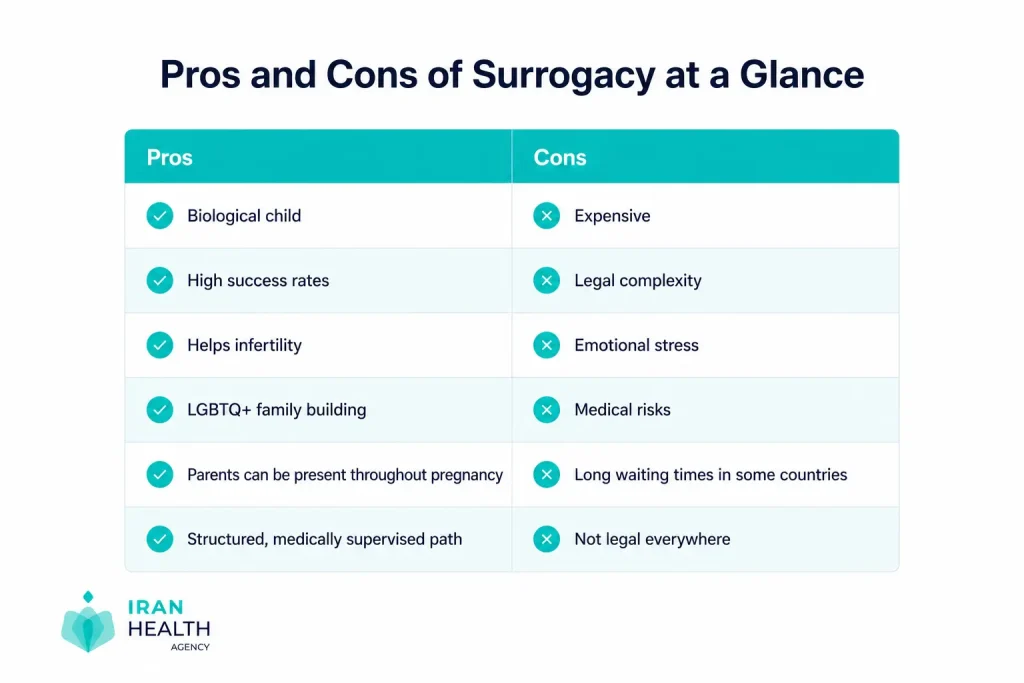
Pros and Cons of Surrogacy at a Glance

Frequently Asked Questions
Is surrogacy better than adoption?
Neither is universally better; they serve different needs. Surrogacy allows a genetic connection to the child and involvement throughout pregnancy; adoption doesn’t require fertility treatment and can be faster in some cases. The right choice depends on your specific priorities and circumstances.
What is the biggest disadvantage of surrogacy?
Cost and legal complexity are consistently the two most cited challenges, since both vary enormously by country and can significantly affect timeline and total financial commitment.
What are the emotional risks of surrogacy?
Both the surrogate and intended parents can experience real emotional strain the surrogate in carrying and relinquishing a pregnancy, and intended parents in navigating the loss of control that comes with not carrying the pregnancy themselves, on top of any prior infertility grief.
Why do people choose surrogacy?
Common reasons include infertility, an inability to safely carry a pregnancy, being part of an LGBTQ+ family building a household, and repeated IVF failure using other methods.
Is surrogacy expensive?
Yes, in most established programs, though costs vary substantially by country and program structure. Getting a complete, itemized quote, not just a headline number, is essential before committing.
Final Thoughts
Surrogacy can be a genuinely life-changing path to parenthood, but it isn’t a decision to make from a blog post alone. Given how much legal frameworks differ by country and how medically involved the process is, speak with both a qualified fertility specialist and a lawyer experienced in surrogacy law in your specific jurisdiction before taking any concrete steps. If you’re exploring options abroad, our guide to surrogacy in Iran covers one increasingly researched destination in detail.
Sources
● American Society for Reproductive Medicine — https://www.asrm.org
● ACRC Global, “Surrogacy Statistics 2026: Success Rates, Costs & Key Data” https://www.acrcglobal.com/post/surrogacy-statistics-2026-success-rates-costs-key-data
● OVU.com, “Surrogacy in the USA 2026: State Laws, Costs & Finding a Surrogate” https://ovu.com/fertility-insights/surrogacy-in-the-usa-2026-state-laws-costs-finding-a-surrogate
●Physician’s Surrogacy, “Surrogacy Success Rates: What the Numbers Mean (2026)” — https://physicianssurrogacy.com/blog/surrogacy-success-rates/