
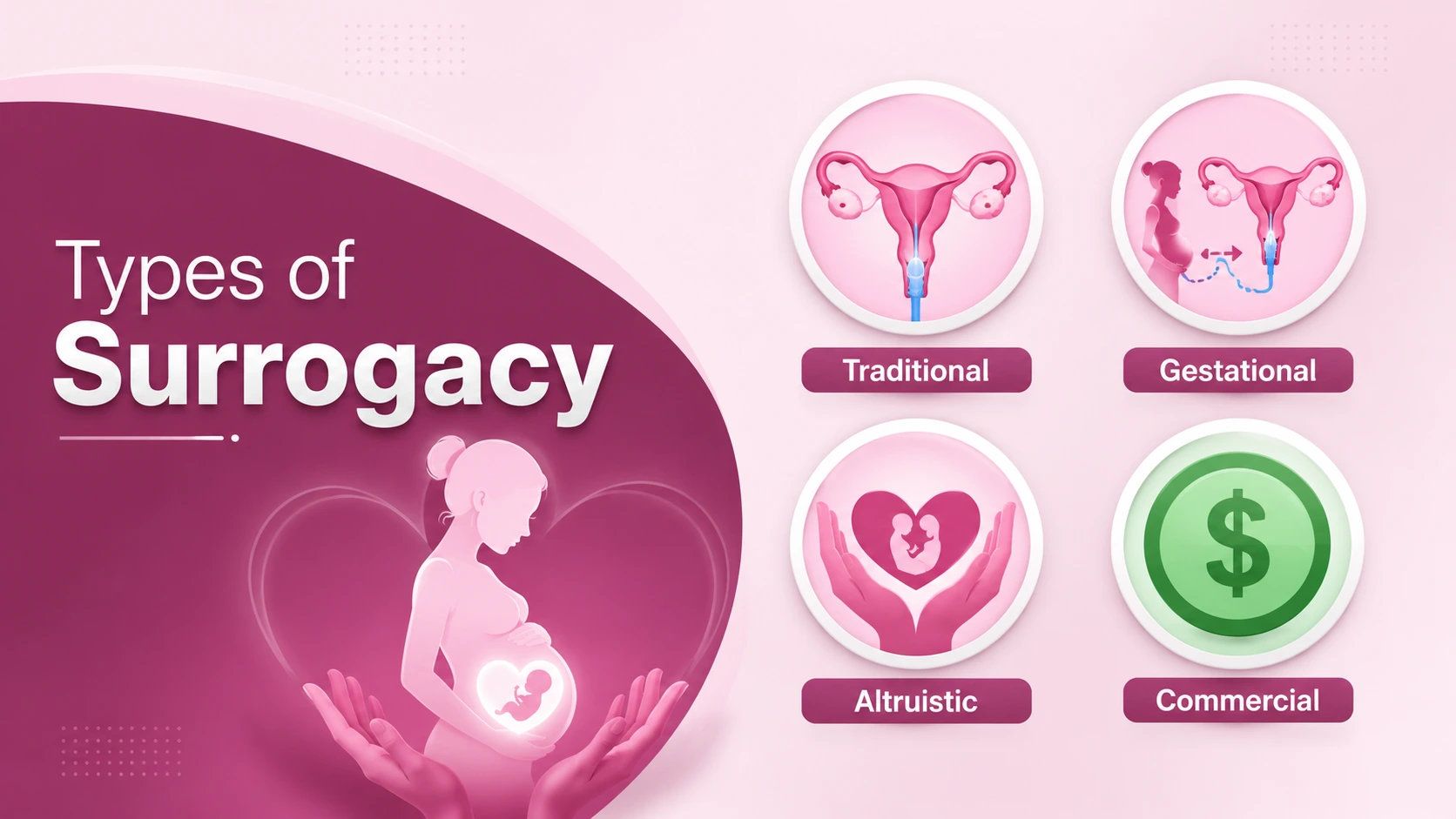

Types of Surrogacy: A Simple Guide to Every Option

type of surrogacy

Table of Contents

If you just started researching surrogacy, you have probably noticed something: every website seems to give you a different answer. One source says there are two types of surrogacy. Another says four. A few list six or more. That kind of inconsistency is genuinely confusing and one of the most common sources of frustration for people when they first explore this path to parenthood.

Here is the honest truth: the confusion usually comes from mixing up two completely different things. Some sources are talking about the medical type of surrogacy (how the pregnancy happens biologically). Others are discussing the legal or financial arrangements (how the surrogate is compensated and which laws apply). Once you understand that difference, everything becomes much clearer.

This guide will walk you through it all in plain language, so that by the time you finish reading, you will know exactly what your surrogacy options are and which questions to ask next.

How Many Types of Surrogacy Are There?

The short answer: two main medical types. Almost every respected medical and legal organization in the world, including the American Society for Reproductive Medicine (ASRM) and the American College of Obstetricians and Gynecologists (ACOG), recognizes the same two core categories when it comes to what the types of surrogacy are:

  • Traditional surrogacy: the surrogate is genetically related to the baby.

  • Gestational surrogacy: the surrogate has no genetic connection to the baby.

Everything else you read about, altruistic surrogacy, commercial surrogacy, and independent surrogacy,  falls under the umbrella of legal and financial arrangements, not separate medical types. We will cover those, too, because they matter a great deal when you actually plan your journey. But the medical foundation starts with just two.

 2026 Data Point: According to a 2026 market analysis by Mordor Intelligence, gestational surrogacy accounted for 91.88% of revenue in 2025, confirming that it is by far the dominant model practiced today. The global surrogacy market is valued at USD 28.91 billion in 2026.

Type 1: Traditional Surrogacy

What It Is

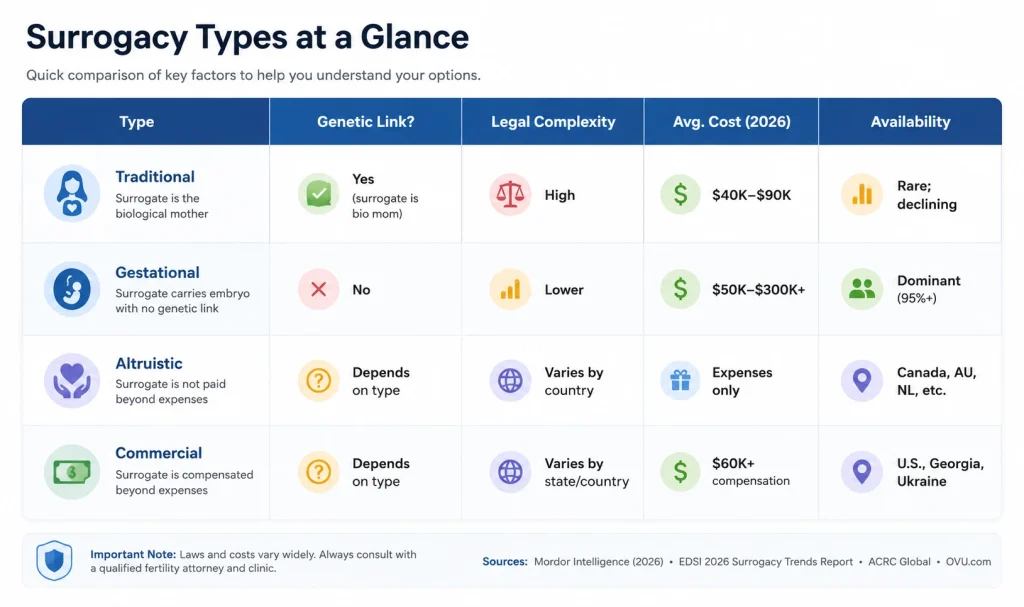
In traditional surrogacy, the surrogate uses her own egg. That means she is the biological mother of the child she carries. The egg is fertilized using the intended father’s sperm or donor sperm, usually through a procedure called intrauterine insemination (IUI) or, less commonly, IVF.

This was actually the original form of surrogacy, used before IVF technology became widely available. Today, it is far less common.

How It Works

  • The surrogate’s egg is fertilized using the intended father’s sperm or donor sperm.

  • Fertilization happens through IUI (the simpler, lower-cost option) or through IVF if genetic screening is needed.

  • The surrogate carries the pregnancy to term and, after birth, legally transfers parental rights to the intended parents.

Costs

According to a 2026 comparison guide by OVU.com, traditional surrogacy usually costs between $40,000 and $90,000, significantly less than gestational surrogacy, largely because it skips the IVF embryo transfer process.

Why It Is Rarely Used Today

Despite the lower cost, traditional surrogacy comes with serious legal and emotional complexities. Because the surrogate is also the biological mother, her parental rights are harder to terminate. Courts in many countries and U.S. states treat this differently from gestational arrangements, and there have been high-profile cases where surrogates challenged the intended parents’ custody.

Professional bodies like ASRM and ACOG strongly favor gestational surrogacy and advise extra caution, or outright avoidance of traditional arrangements.

Type 2: Gestational Surrogacy

In gestational surrogacy, the surrogate, often called a gestational carrier, has no genetic relationship to the baby. The embryo is created in a laboratory using IVF, combining the intended mother’s egg (or a donor egg) with the intended father’s sperm (or donor sperm). The embryo is then transferred into the surrogate’s uterus.

This is the most common and most legally straightforward form of surrogacy practiced today. According to ACRC Global’s 2026 Surrogacy Statistics, gestational surrogacy now represents over 95% of all surrogacy arrangements globally, with traditional surrogacy becoming increasingly rare.

How It Works

  • An embryo is created through IVF using eggs and sperm from the intended parents, donors, or a combination.

  • The embryo is transferred to the surrogate’s uterus in a fertility clinic procedure.

  • The surrogate carries the pregnancy with no genetic link to the baby.

  • Legal parentage is typically established before birth through a pre-birth order.

Costs

Gestational surrogacy is more expensive because it requires IVF. According to the 2026 U.S. Surrogacy Trends Report by EDSI, most full U.S. programs fall between $150,000 and $220,000, with complex cases, multiple IVF cycles, donor eggs, and live birth guarantees reaching $250,000 to $300,000. Internationally, programs in countries such as Colombia, Mexico, and Georgia typically cost $50,000 to $80,000.

Why It Is the Preferred Model

The legal clarity is the main reason. Because the surrogate has no genetic link to the child, courts across most jurisdictions find it far easier to establish the intended parents’ legal rights. The emotional boundaries are also cleaner, which reduces the risk of disputes during and after the pregnancy.

Expert Consensus (2026): The ESHRE Ethics Committee’s 2025 position paper reviewed European legal frameworks and emphasized that gestational surrogacy offers stronger protections for child welfare, surrogate welfare, and legal clarity especially for intended parents navigating cross-border arrangements.


Why Do Some Sources Say There Are 4 Types of Surrogacy?

Why Do Some Sources Say There Are 4 Types of Surrogacy?

You will often see articles listing four kinds of surrogacy. Here is why: they are layering the legal/financial model onto the medical model. The four commonly cited categories are:

  • Traditional surrogacy

  • Gestational surrogacy

  • Altruistic surrogacy

  • Commercial surrogacy

The first two are about biology. The last two are about money and law. They are not parallel categories; they overlap. A gestational surrogacy can be either altruistic or commercial. So can a traditional surrogacy. Here is what each one means:

Altruistic Surrogacy

In altruistic surrogacy, the surrogate receives no financial payment beyond reimbursement for reasonable expenses like medical bills and travel. She is motivated by a desire to help — often she is a friend or family member of the intended parents.

According to the UK Law Commission’s 2023 report (cited by Brilliant Beginnings), true altruistic surrogacy means no fee is paid beyond out-of-pocket expenses. Countries such as Canada, Australia, and the Netherlands permit only this model.

Commercial Surrogacy

In commercial surrogacy, the surrogate receives financial compensation for her time and the physical demands of pregnancy, in addition to expense reimbursements. This is the standard model in the United States, Georgia, and Ukraine.

According to the Society for Assisted Reproductive Technology (SART), commercial surrogacy involves payment that goes beyond reasonable expenses. In the U.S. in 2026, surrogate base compensation often starts around $60,000, with total compensation, including allowances, milestone payments, and reimbursements, reaching $80,000 to $110,000 or more, according to the EDSI 2026 Trends Report.

It is worth noting that commercial arrangements are not automatically transactional or impersonal. Many commercial surrogacy journeys result in lasting friendships. The label reflects the payment structure, not the emotional quality of the relationship.

Key Takeaway: Altruistic vs. commercial is a legal and financial distinction, not a medical one. Most gestational surrogacies in the U.S. are commercial. Most in Canada are altruistic. Both can produce the same positive outcome for intended parents and surrogates.

Surrogacy Options for Intended Parents: Independent vs. Agency

Once you understand the different types of surrogacy medically and legally, the next practical decision is how you will organize your journey. There are two main paths:

Independent Surrogacy

In independent surrogacy (also called private surrogacy), intended parents find and work with a surrogate without using a third-party agency. They coordinate directly with a reproductive attorney, a fertility clinic, and the surrogate herself.

The main appeal is cost control. According to OVU.com’s 2026 Cost Guide, going independent can save the agency fee, typically $20,000 to $40,000, bringing independent journeys to an average of $100,000 to $150,000 overall. You also have more direct control over who you work with and how decisions get made.

The trade-off: you take on all the coordination yourself. Finding and screening a surrogate, drafting legal contracts, managing escrow, and handling unexpected complications all fall on the intended parents. This can be overwhelming, especially for first-time intended parents who are already emotionally invested in the outcome.

Agency-Based Surrogacy

In agency-based surrogacy, a professional agency manages the process on your behalf. The agency recruits, screens, and matches surrogates; coordinates with the fertility clinic and attorneys; sets up escrow accounts; and provides ongoing support through pregnancy and delivery.

According to Physician’s Surrogacy’s 2026 cost breakdown, most professional agency journeys in 2026 range from $120,000 to $220,000, with California-based programs often exceeding $200,000. In return, agencies report live-birth success rates of 90–99% for their clients, thanks to thorough surrogate screening and professional monitoring.

A note worth considering: some families pursue independent surrogacy to save money and end up spending more time and money resolving issues that an agency would have prevented. The agency fee is real, but so is the value of expert coordination and legal protection when things do not go as planned.

International Surrogacy

For intended parents facing legal restrictions in their home country, or simply looking to manage costs, international surrogacy is a third path. Countries with accessible surrogacy programs in 2026 include the United States (for high legal protection), Georgia, Colombia, Mexico, and parts of Eastern Europe and Southeast Asia.

Legal reforms in multiple countries are actively reshaping international patient flows in 2026, so it is essential to consult a reproductive attorney familiar with both your home country’s laws and the destination country’s regulations before proceeding.

Type of surrogacy

Conclusion

So here is where we land. Surrogacy is not as complicated as it first appears, but it does require understanding the difference between medical types and legal arrangements. At its core, there are two types of surrogacy: traditional and gestational. Gestational surrogacy is the dominant model today, used in over 95% of all cases globally, because it offers stronger legal protections and no genetic ambiguity.

On top of those two medical types, you layer a financial model (altruistic or commercial) and an organizational model (independent or agency-based). Put all of that together, and you have a clear map of every surrogacy option available to you.

If you are an intended parent exploring this path for the first time, the most important next step is to consult with a qualified reproductive attorney in your jurisdiction and to connect with a reputable fertility clinic. Every journey is personal, and the right combination of surrogate types, legal structures, and support systems will depend on your family’s unique situation.

Planning to pursue surrogacy through medical tourism? IranHealthAgency.com connects intended parents with vetted fertility clinics and legal advisors across multiple countries. Reach out to explore your options with expert guidance.

Free Consulation

FAQ

How many types of surrogacy are there?

Medically, there are two main types of surrogacy: traditional surrogacy (where the surrogate is genetically related to the baby) and gestational surrogacy (where the surrogate has no genetic link). When you add legal and financial arrangements — altruistic vs. commercial, independent vs. agency-based — the number of categories grows, but the medical foundation remains the same two.

What is the most common type of surrogacy?

Gestational surrogacy is the most common type by a wide margin. According to ACRC Global’s 2026 data, gestational surrogacy represents over 95% of all surrogacy arrangements globally. In the United States specifically, that figure is also over 95% as of the most recent data. The primary reasons are legal clarity and the fact that the surrogate has no biological claim to the child.

Is altruistic surrogacy better than commercial surrogacy?

Neither is inherently better — they serve different legal and personal contexts. Altruistic surrogacy options may feel more personal when the surrogate is someone you already know and trust. Commercial surrogacy, on the other hand, provides a structured framework with legal protections, clear contracts, and compensation that acknowledges the significant physical and emotional commitment involved. The right choice depends on your circumstances, location, and values.

Can I do surrogacy without an agency?

Yes. Independent surrogacy is legal in most U.S. states and many other countries. It can reduce costs by $20,000 to $40,000 by eliminating agency fees. However, you take on full responsibility for finding, screening, and coordinating with your surrogate, as well as managing all legal and medical logistics. Most fertility experts recommend working with at minimum a qualified reproductive attorney, even if you skip the agency.

Sources & Citations

0 0 votes
Article Rating
0 Comments
Oldest
Newest Most Voted
Inline Feedbacks
View all comments
WhatsApp