
IVF in Iran
Considering IVF in Iran?
Start with a free consultation.
Contact us now!
- Fellowship-trained fertility specialists
- Staying Time: 10-14 Days
- Cost: from $2,500
- Shorter wait times
- Free Consultation
IVF in Iran at a glance
- IVF in Iran: Advanced fertility treatment with modern clinics, experienced specialists, and affordable costs compared with many countries.
- IVF process: Online consultation → fertility evaluation → ovarian stimulation → egg retrieval → fertilization in the lab → embryo transfer → pregnancy test and follow-up.
- Cost & duration: IVF treatment in Iran usually costs around $2,500–$6,000 per cycle. Most international patients stay about 10–14 days for the treatment process.
- Success rate: Results depend on factors such as age, egg quality, sperm quality, and medical condition. Younger patients generally have higher success chances, and IVF does not guarantee a pregnancy.
- Available services: IVF, ICSI, egg donation, sperm donation, embryo freezing, and genetic testing (PGD/PGS) are available based on each couple’s needs.
- Patient support: Treatment packages can include specialist consultation, clinic coordination, medical guidance, accommodation support, transfers, and multilingual assistance for international patients.
Related videos about IVF in Iran
IVF in Iran is a lower-cost option for couples seeking assisted reproduction: a cycle typically costs $2,500 to $6,000, well below prices in the US and much of Europe. Outcomes depend mainly on the woman’s age and the diagnosis, and no clinic can guarantee a pregnancy.
Iran Health Agency coordinates care through a network of IVF centers and fertility specialists. The workflow starts with a remote review of your medical documents, followed by a scheduled consultation with the chosen doctor to discuss diagnosis, expected success rate, treatment plan and budget. Most pre-arrival steps, including document review and planning, are completed within one to two working days.
Success rates fall with age; the figures, and their limits, are set out in the success rate section below. Any treatment decision is made with your treating physician.
How Much Does IVF Cost in Iran?
A complete IVF cycle in Iran typically costs $2,500 to $3,500 with your own eggs and $3,000 to $6,000 when donor eggs, ICSI or genetic testing are added. Our packages for international patients, listed below, are $3,000, $3,500 and $4,500. The final quote depends on your diagnosis and protocol.
Packages cover consultation, monitoring, routine medications, egg retrieval, lab work, embryo transfer and the pregnancy test. By comparison, a single IVF cycle in the United States often exceeds $15,000 before medications and add-ons, while many European destinations fall between $4,000 and $8,000. For a line-by-line view, see our detailed breakdown of IVF treatment costs in Iran.
IVF in Iran packages
Choose the package that matches your treatment plan. Hotel nights are optional add-ons. Canadian, American, and British visas have a separate fee.
ECONOMY
Platinum Care Package
$3,000
Treatment package
IVF
- Complete Routine Lab Test
- Medical Consultation
- Ultrasounds
- Airport Pickup
- Sperm Analysis Test
- Doctors Visits
- Hormonal Tests
- Translation
- ICSI Method
- SIM Card with Internet
- Embryos Transfer
- Follow-up
- Embryo Freezing
- Sightseeing in Tehran
- Routine Medicines
- Travel Planning
MOST CHOSEN
Sapphire Care Package
$3,500
Treatment package
- IVF + EGG DONATION
IVF
- Complete Routine Lab Test
- Medical Consultation
- Ultrasounds
- Airport Pickup
- Sperm Analysis Test
- Doctors Visits
- Hormonal Tests
- Translation
- ICSI Method
- SIM Card with Internet
- Embryos Transfer
- Follow-up
- Embryo Freezing
- Sightseeing in Tehran
- Routine Medicines
- Travel Planning
PREMIUM
Diamond Care Package
$4,500
Treatment package
- IVF + PGD (PGS)
IVF
- Complete Routine Lab Test
- Medical Consultation
- Ultrasounds
- Airport Pickup
- Sperm Analysis Test
- Doctors Visits
- Hormonal Tests
- Translation
- ICSI Method
- SIM Card with Internet
- Embryos Transfer
- Follow-up
- Embryo Freezing
- Sightseeing in Tehran
- Routine Medicines
- Travel Planning
Note: Our IVF with egg donation package uses fresh eggs by default. A frozen egg can be used if you have a specific medical situation or concern; the choice depends on your wishes and your doctor’s diagnosis.
The cost of IVF varies widely across the world, which makes affordability a key consideration for many couples. In the United States, a single cycle can range from $15,000 to $20,000, excluding additional expenses such as medications. Pricing in Iran starts at $2,500. Explore this financial analysis.
IVF cost components: Iran compared with prices elsewhere
| Cost Component | Reference price outside Iran (USD) | Price Range in Iran (USD) |
| Initial Consultation | $225–$500 | Free with Iran Health Agency |
| IVF Cycle with Fresh Eggs | $14,715–$20,215 | $2,500–$3,500 |
| IVF Cycle with Frozen Eggs | $14,055–$19,615 | $2,500–$3,500 (estimate) |
| IVF Cycle with Frozen Eggs, Biopsy, and PGT-A | $17,100–$23,950 | Quoted individually; biopsy and PGT-A are additional |
| Embryo Freezing | Various | $200–$500 |
- Assessing Fertility: Approximately $250 to $500.
- Sperm Analysis: Around $200 to $250.
- IVF Cycle Medications (Injection): Between $3,000 to $6,000.
- Retrieving Eggs: These are most often included in the IVF cycle fee.
- Anesthesia Services: Typically included up to $725 in the IVF cycle fee.
- Donor Sperm: Costs between $300 to $1,600.
- Intracytoplasmic Sperm Injection (ICSI): Usually included in the IVF cycle fee (up to $2,000).
- Embryo Cryopreservation: Approximately $1,000 to $2,000.
- Embryo Storage: Around $350 to $600 yearly.
- Frozen Embryo Transfer (FET): Typically included in the IVF cycle fee (up to $6,400).
- When using a Gestational Carrier, patients can expect to pay medical and legal fees ranging from $60,000 to $150,000.
The IVF process in Iran, step by step
IVF in Iran follows the same clinical steps as elsewhere, arranged around a stay of about 10 to 14 days. The outline below shows what happens at each stage; your specialist sets the exact protocol after reviewing your records.
Online consultation and fertility evaluation
Before you travel, your medical documents are reviewed and a consultation is scheduled with the chosen doctor. The evaluation includes ultrasound, hormonal blood tests (including AMH to check ovarian reserve) and a sperm analysis, and counselling is offered to help manage stress during treatment. Related reading: causes of male infertility and drugs that can affect female fertility.
Ovarian stimulation
The woman is given fertility medications and hormonal injections to stimulate the ovaries to produce several mature eggs, with ultrasound monitoring along the way. If you are earlier in your treatment path, see ovulation induction in Iran.
Egg retrieval
Once the eggs are ready, they are retrieved from the ovaries in a minor procedure guided by ultrasound. A thin needle is passed through the vagina to aspirate the eggs from the follicles.
Fertilization
The retrieved eggs are combined with the sperm sample in the laboratory. With ICSI, which is part of our packages, a single sperm is injected directly into each egg.
Embryo culture
The fertilized eggs (embryos) grow and develop in an incubator for a few days. Embryos that are not transferred can be frozen.
Embryo transfer
One or more embryos are transferred into the uterus through the cervix using a thin catheter. How many embryos to transfer is decided with your doctor.
Pregnancy test and follow-up
A blood pregnancy test (beta-hCG) is done about two weeks after the embryo transfer to see whether the cycle worked. Follow-up after you return home is arranged remotely with the doctor.
What are the risks of IVF?
IVF is an established treatment, but it carries risks and does not guarantee a pregnancy. The main ones are ovarian hyperstimulation syndrome (OHSS), multiple pregnancy, complications of egg retrieval or sedation, ectopic pregnancy, emotional strain and the possibility that a cycle does not succeed. Your treating physician explains how these apply to you.
- Ovarian hyperstimulation (OHSS): the ovaries can over-respond to stimulation drugs, which is why the stimulation phase is monitored. See this overview of IVF procedures and their risks.
- Multiple pregnancy: transferring more than one embryo raises the chance of twins or more, with higher risks for mother and babies.
- Procedure-related complications: egg retrieval is a minor procedure, but complications can occur.
- Ectopic pregnancy and unsuccessful cycles: both are possible, and more than one cycle may be needed.
- Emotional strain: treatment abroad adds travel and waiting to an already demanding process.
Contact your doctor promptly if you feel unwell after treatment. This page is general information and does not replace medical advice; for a balanced view, read the advantages and disadvantages of IVF.
IVF patient stories
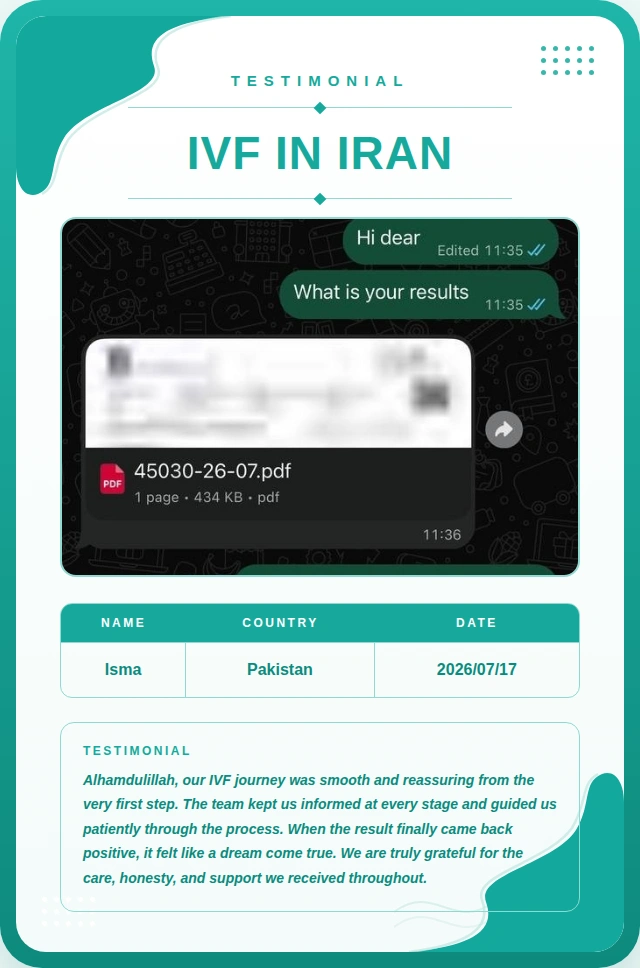
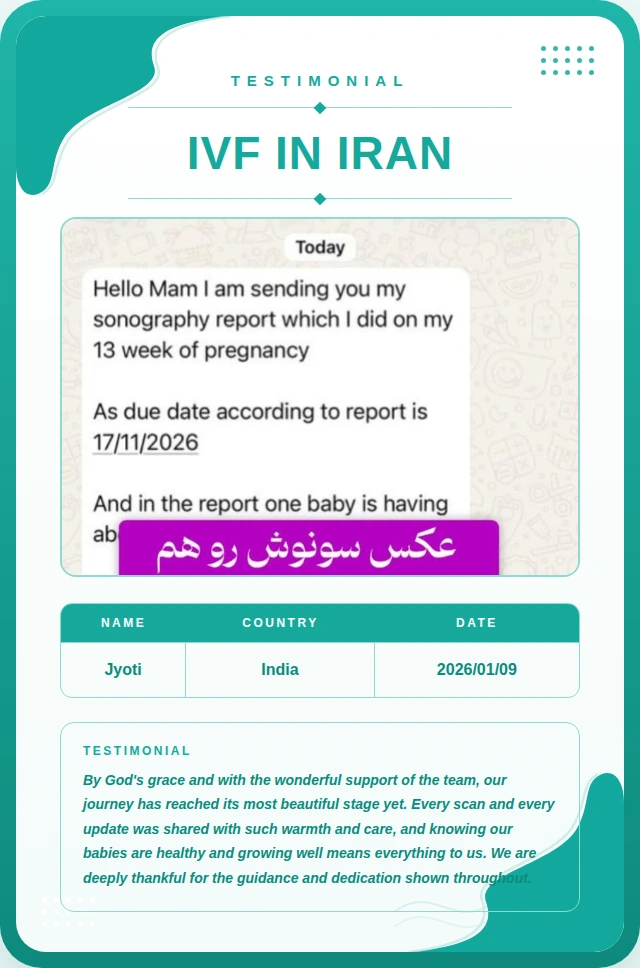
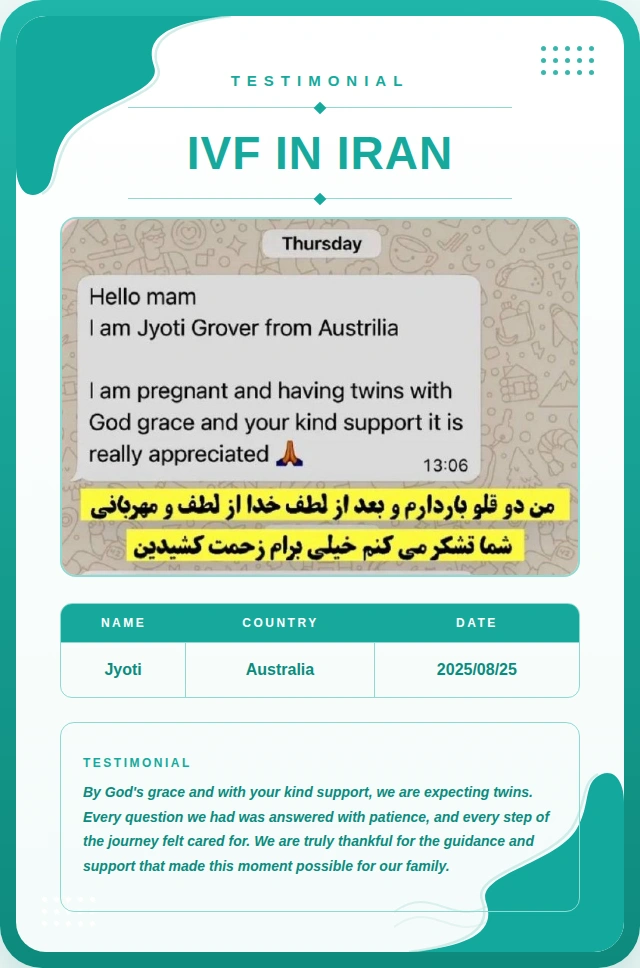
Watch: IVF in Iran explained
What is included in an IVF package in Iran, and what is not?
Our IVF packages include the medical consultation, routine lab and hormonal tests, sperm analysis, ultrasounds, routine medicines, the ICSI method, embryo transfer, embryo freezing and follow-up, plus airport pickup, translation, a SIM card, travel planning and sightseeing in Tehran. Hotel nights are optional add-ons, and Canadian, American and British visas carry a separate fee.
Depending on the package, you also get:
- A free consultation to understand your needs
- Comprehensive fertility testing
- Genetic screening (PGD/PGS) in the IVF + PGD package
- A personal assistant and VIP transfer
- Hotel accommodation as an optional add-on
- Planning of every step from start to finish by our coordinator
- Multilingual support (English, Arabic and other languages)
Planning your trip: stay, visa and follow-up
Most international patients stay about 10 to 14 days. Document review and planning are completed before you arrive, usually within one to two working days. For entry requirements, see how the Iran medical visa works; visa rules and fees differ by nationality and can change. After the embryo transfer, follow-up with the doctor continues remotely once you are home.
What is the IVF success rate in Iran?
According to Iran Health Agency’s own figures, the IVF success rate in Iran is about 40% for women under 35, 32–35% at ages 35 to 37, under 10% at 38 to 40 and under 5% over 40. The measure used and the period covered are not published with these figures, so treat them as indicative, not as a prediction.
| Woman’s age | Reported IVF success rate in Iran |
|---|---|
| Under 35 | Approximately 40% |
| 35 to 37 | 32% to 35% |
| 38 to 40 | Less than 10% |
| Over 40 | Less than 5% |
Source: Iran Health Agency (IHA) report. IVF does not guarantee a pregnancy at any age. For more detail, see our IVF success rate in Iran report.
What affects your chances of IVF success?
Age is the strongest factor, followed by ovarian reserve (measured with AMH, the Anti-Müllerian Hormone), sperm quality, embryo quality and the health of the uterus. Lifestyle also plays a part, and donor eggs can change the picture for women with a low reserve. Your specialist weighs these after the fertility evaluation and sets the protocol.
How Iran Health Agency supports your treatment
- Egg donation: where donor eggs are indicated, we arrange fresh eggs from donors aged 18 to 25.
- Medication monitoring: our team follows your medication schedule and stays in contact throughout the cycle.
- Choice of specialist: our doctors are infertility sub-specialists; we suggest one based on your diagnosis.
- Choice of facility: we select hospitals and centers equipped for IVF treatment.
- Uterine health assessment: the uterus is assessed before transfer so that problems can be identified and addressed.
- Male factor care: where sperm quality is an issue, medication or a minimally invasive procedure may be recommended by the specialist.
- Dedicated nurse: on request, a nurse can give your injections on time at your residence.
Clinics check ovarian reserve with AMH and adjust medication plans to each patient, and many also give lifestyle advice on nutrition and stress management. After the transfer, doctors check in with patients through telemedicine, which allows guidance without extra trips.
How do IVF success rates in Iran compare with other countries?
Direct comparison is unreliable, because clinics and countries report different measures: some count clinical pregnancies, others live births, per cycle or per embryo transfer. Published studies put live birth rates for women under 35 at around 30–39% per embryo transfer cycle in the UK and US, in the same range as the roughly 40% reported in Iran for that age group.
For how live birth rates vary by repeat cycles and age internationally, refer to scientific studies on repeat IVF cycles.
Why do international patients choose Iran for IVF?
International patients choose IVF in Iran mainly for cost: a cycle starts at $2,500, against $15,000 or more in the United States. Other reasons are shorter wait times, fertility specialists with infertility fellowships, and packages that organise travel, translation and transfers around a 10 to 14 day stay. The outcome is never guaranteed.
There are limits to weigh as well: visa rules and fees differ by nationality, follow-up after you return home is remote, and success depends on your age and diagnosis. For background, read about the quality of Iran’s healthcare system.
Which are the best-known IVF centers in Iran?
Iran has a number of well-known IVF centers. Bahman Hospital and Royan Institute are among the most widely recognised for infertility treatment. The eight centers shown below are in Tehran and other large cities; the list is not a ranking, and we suggest a clinic based on your diagnosis, budget and preferences.
How to choose an IVF clinic: ask whether the center holds a current licence, how much infertility experience its team has, how it defines and reports its success rates, what its embryology laboratory offers, how many embryos it transfers, whether it supports patients in your language, and what the quoted price includes. To discuss the options and book a consultation, contact us on WhatsApp.

Royan

Hazrat e Maryam

MOM

Bahman

Ebne Sina

Amin

Shiraz

Armaghan
How does the cost of IVF in Iran compare with other countries?
IVF in Iran costs about $2,500 to $6,000 per cycle. In the same comparison, Turkey is listed at $2,500 to $8,000, India at $1,200 to $6,000, the United Kingdom at $3,500 to $7,000 and the United States at $15,000 to $40,000. These are estimates for the medical procedure only, without travel, and they are not quotes.
| Country | IVF Cost (USD) |
| Spain | $4,300–$8,700 |
| Poland | $2,745–$5,595 |
| Czech Republic | $2,000–$5,700 |
| Greece | $3,270–$6,540 |
| Turkey | $2,500–$8,000 |
| Iran | $2,500–$6,000 |
| Mexico | $6,000 |
| Cyprus | $3,500–$7,000 |
| Thailand | $4,500–$10,000 |
| India | $1,200–$6,000 |
| United States | $15,000–$40,000 |
| United Kingdom | $3,500–$7,000 |
Success rates are left out of this table on purpose: countries and clinics report them with different definitions, so the figures are not directly comparable.
Fertility specialists you can consult
The specialists below are obstetrician-gynecologists with infertility fellowships, together with a urologist for male infertility. Your coordinator suggests a doctor based on your diagnosis, and the doctor develops a treatment plan for your case. Each name links to the doctor’s profile.


You can read more about each doctor on their profile page, linked from the names above.
Frequently asked questions about IVF in Iran
How much does IVF cost in Iran?
A complete IVF cycle in Iran typically costs $2,500 to $3,500 with your own eggs and $3,000 to $6,000 when donor eggs, ICSI or genetic testing are added. Our packages for international patients are $3,000, $3,500 and $4,500. Hotel nights are optional, and some visas carry a separate fee. See the cost of IVF treatment in Iran.
What is the IVF success rate in Iran?
According to Iran Health Agency figures, about 40% for women under 35, 32 to 35% at ages 35 to 37, under 10% at 38 to 40 and under 5% over 40. The measure and period behind these figures are not published, results are individual, and IVF does not guarantee a pregnancy.
How long do I need to stay in Iran for IVF?
Most international patients stay about 10 to 14 days. Document review and treatment planning are done remotely before you arrive, usually within one to two working days, and follow-up after the embryo transfer continues remotely once you are home.
Which are the best IVF centers in Iran?
Well-known IVF centers in Iran include Royan Institute and Bahman Hospital, alongside Hazrat e Maryam, MOM, Ebne Sina, Amin, Shiraz and Armaghan. This is not a ranking: the right clinic depends on your diagnosis, budget and preferences, and we suggest one after reviewing your records.
What is included in an IVF package in Iran?
Packages include the medical consultation, routine lab and hormonal tests, sperm analysis, ultrasounds, routine medicines, ICSI, embryo transfer, embryo freezing and follow-up, plus airport pickup, translation, a SIM card and travel planning. Hotel nights are optional add-ons, and Canadian, American and British visas have a separate fee.
Is an AMH test part of IVF in Iran?
Yes. AMH (Anti-Mullerian Hormone) is used to check ovarian reserve before the protocol is set, and hormonal tests are included in our IVF packages. If you already have a recent AMH result, send it with your medical documents so the doctor can review it before you travel.
Is IVF in Iran safe?
IVF carries the same risks in Iran as elsewhere: ovarian hyperstimulation (OHSS), multiple pregnancy, complications of egg retrieval, ectopic pregnancy and unsuccessful cycles. Stimulation is monitored to reduce these risks, but no clinic can remove them or guarantee an outcome. Discuss your own risk with the treating physician.
Do I need a visa to travel to Iran for IVF?
Most international patients need a visa, and requirements and fees differ by nationality; Canadian, American and British visas carry a separate fee. Our team helps plan the trip. See our guide to the Iran medical visa for how the process works, and check the current rules before you book. Iran medical visa guide.
What is the difference between IVF and surrogacy?
In IVF, the embryo is transferred to the intended mother, who carries the pregnancy. In surrogacy, an embryo created by IVF is carried by another woman. Surrogacy is considered only when the intended mother cannot carry a pregnancy for medical reasons; your specialist advises which applies to you. Read more on the difference between IVF and surrogacy.
Start with a free IVF consultation
Send us your medical documents on WhatsApp. They are reviewed, a consultation with the chosen doctor is scheduled, and you receive a treatment plan and a cost estimate before you commit to anything. This page is general information, not medical advice.
My sister and her husband have unfortunately been struggling with infertility for a few years now. They mentioned that they may want to look into IVF treatment to hopefully have a child, but they aren’t too familiar with the details yet. I want to help gather some information for them to understand their options.
I know they would specifically want to know about the situation in Iran since that’s where we’re originally from. So I wanted to ask some questions they had in mind. First off, is IVF technology legal to use there? I’m pretty sure it is, but just wanted to double-check since I know every country has different regulations.
Yes, you are correct that in vitro fertilization (IVF) treatment is legal and available in Iran. Iran has become one of the leading countries in the Middle East for assisted reproductive technology and infertility services over the past few decades.
The government and Ministry of Health have sanctioned the use of technologies like IVF, artificial insemination, egg/sperm donation and surrogacy since the 1990s as safe and ethical options for couples struggling with infertility to build families. There are robust regulations and oversight in place to support access while ensuring patient rights and standards of care are upheld.
Today, Iran boasts over 80 dedicated fertility clinics across the country equipped with state-of-the-art laboratories, reproductive endocrinologists and embryologists trained internationally, and innovative treatment protocols personalized to each couple’s needs. Services rival top global IVF centers at a fraction of the cost for both nationals and medical tourists.
For someone like me who needs advanced fertility treatments, can Iranian clinics handle everything from IVF to ICSI to egg donation under one roof?
Iranian clinics provide a whole range of services, including in vitro fertilisation (IVF), in vitro seeding (ICSI), and egg donation, all in one place, making the tremendous journey of fertility treatments much more manageable for patients. These clinics provide an easy experience, directing you at every step, with their modern facilities and staff of caring experts.
My doctor recommended intrauterine insemination before exploring IVF. Is this a common fertility procedure in Iranian clinics as well?
Yes, a typical reproductive method given at Iranian clinics is intrauterine insemination (IUI). In vitro fertilization (IVF) is a more sophisticated method that can boost a couple’s chances of getting pregnant, but in vitro fertilization (IUI) is a less intrusive and effective way to start.
I know Iran offers very affordable IVF, but are their clinics also experienced in pre-implantation genetic diagnosis for high-risk cases?
Iran is known for providing affordable IVF treatments, and its clinics are well-versed in advanced techniques such as pre-implantation genetic diagnosis (PGD). This advanced procedure is beneficial for high-risk cases as it allows the screening of embryos for potential genetic disorders before implantation. This increases the chances of a successful and healthy pregnancy
Is IVF in Iran cheaper for people that have a persian passport? One of my family live in Nethrland and has a IRanian passport. She will come to iran next month and wants to know can she pays for IVF in persian rials?
yes
they ones with Iranian national code will get cheaper price
Thanks to the Iran Health Agency, our dream of having a child came true. The doctors and staff were kind, clear, and knowledgeable as they walked us through every step of IVF and surrogacy. We felt supported from the first day until our baby was born.