Every week, IHA meets intended parents who arrive at surrogacy with two very different lists in hand: one full of hope, and one full of hard questions. Is this fair to the surrogate? Is paying her a form of exploitation, or is it simply respecting her labor? What happens if something goes wrong? The ethics of surrogacy isn’t a single debate with a clean answer; it’s a cluster of overlapping questions about consent, money, motherhood, and the rights of a child who has no say in how they came into the world.
This article walks through that terrain honestly, the way we would in a consultation room: laying out the strongest arguments on each side, the medical and legal safeguards that actually reduce harm, and where major religious traditions and professional bodies land. My aim isn’t to tell you what to think. It’s to make sure you’re not missing a question you’ll wish you’d asked earlier.
We want to be upfront about something else too: the ethics of surrogacy debate has real people on both sides of every argument, and reducing it to a simple pro/con list does a disservice to everyone involved. A surrogate who found the experience empowering and a surrogate who felt pressured by financial circumstances can both be telling the truth about their own experience.
Good ethical practice means building systems that make the empowering version far more likely and the pressured version far less likely, which is really the thread running through every section below.
Why Is Surrogacy Ethically Controversial?
Surrogacy sits at the intersection of some of the oldest ethical tensions we have: bodily autonomy versus vulnerability, love versus commerce, and individual choice versus social justice. A peer-reviewed ethical analysis published in Human Reproduction frames the core tension well: commercial arrangements are more likely than altruistic ones to raise exploitation concerns, yet banning surrogacy outright can push people toward less regulated, riskier arrangements abroad.
Add to that the fact that surrogacy involves a third party’s body in an intensely personal way, and you can see why regulators, clinicians, and religious authorities have struggled to reach a shared consensus, even decades after the first gestational surrogacy births.
There’s also a practical dimension that keeps this debate alive: surrogacy law is a patchwork. Some countries ban it outright, some permit only altruistic arrangements, and some, like parts of the U.S. and Iran, allow compensated surrogacy under contract. That patchwork means the same ethical question- whether this is fair to everyone involved can have a genuinely different answer depending on which country’s legal protections happen to apply to your specific arrangement.
Ethical Arguments in Favor of Surrogacy
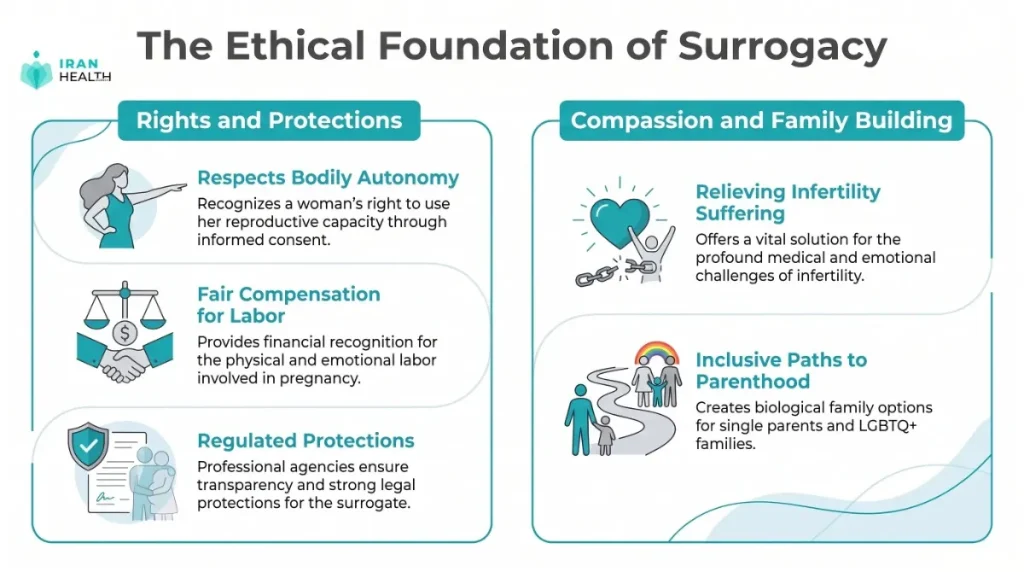
The case for surrogacy usually rests on autonomy and compassion. Supporters argue that a woman capable of informed consent has the right to use her body, including her reproductive capacity, as she sees fit, the same principle that underlies decisions about blood and organ donation. Surrogacy also directly relieves the profound suffering of infertility, offering a path to parenthood for couples facing medical infertility, single people, and LGBTQ+ families who have no other biological option.
- Respects the surrogate’s bodily autonomy and right to informed choice
- Provides fair compensation for real physical and emotional labor
- Creates families for people with no other route to biological parenthood
- Can be conducted through well-regulated, transparent agencies with strong surrogate protections
Ethical Arguments Against Surrogacy
The opposing case centers on exploitation and commodification. Philosopher Alan Wertheimer’s influential framework, discussed in a recent ethical and legal review, holds that exploitation occurs when benefits are unfairly distributed or consent is effectively coerced by financial desperation. A widely cited PubMed analysis takes this further, concluding that commercial surrogacy is often exploitative in practice, even though banning it outright may simply push vulnerable women toward worse alternatives.
Critics also raise the commodification argument: that treating a pregnancy, and by extension a child, as a purchasable service risks reducing both the surrogate’s body and the resulting child to a transaction rather than a relationship.
- Risk of coercion when compensation is the primary motivator for a woman with limited options
- Concerns about commodifying children and reproductive labor
- Unequal power dynamics between wealthier intended parents and lower-income surrogates
- Long-term psychological impact on the surrogate, not always fully studied or disclosed
Commercial Surrogacy Ethics
Commercial surrogacy ethics specifically concerns arrangements where a surrogate receives payment beyond reimbursed medical expenses. The ethics of commercial surrogacy debate hinges on one question: does payment corrupt an otherwise generous act, or does it simply recognize labor that deserves fair compensation? A comparative analysis of the Netherlands and India, published in PMC, argues that commodification and exploitation are real risks but are not unique to surrogacy; they reflect broader global inequality and can be substantially reduced through fair pay and enforceable regulation rather than prohibition.
In practice, this means the ethical weight of a commercial arrangement depends heavily on transparency: clear contracts, fair and disclosed compensation, and a surrogate who was never financially cornered into saying yes.
International Surrogacy Ethics
International surrogacy ethics adds an entire additional layer of risk on top of the commercial debate. When intended parents travel abroad, often to developing countries where surrogacy is cheaper and less regulated, the legal risks multiply: a child may be born stateless if neither country recognizes the arrangement, the surrogate may have weaker legal protections, and continuity of medical care can suffer when treatment spans two health systems.
A case study of a Western Indian clinic, examined in PMC, found that exploitation concerns in cross-border arrangements often stem less from surrogacy itself and more from asymmetric information that surrogates did not fully grasp their contractual terms or long-term risks. This is precisely why due diligence on the receiving country’s legal framework, not just its price point, has become a non-negotiable part of ethical practice.
The practical lesson for intended parents is straightforward, even if it isn’t always comfortable: the cheapest destination is rarely the most ethical one, and a country’s overall regulatory maturity clear parentage law, licensed clinics, mandatory independent legal counsel for the surrogate matters just as much as clinical success rates when you’re choosing where to build your family.
Medical Ethics in Surrogacy
IVF ethics and surrogacy are inseparable, since nearly every gestational arrangement begins with an IVF cycle. The central medical-ethics questions cluster around a few recurring points: how many embryos are created and what happens to unused ones, how embryo transfer decisions are made (including whether to transfer more than one embryo, which raises multiple-pregnancy risk), and whether the surrogate has given genuine informed consent to every medical intervention, not just the pregnancy itself.
Where donor eggs are involved, additional consent and disclosure questions arise regarding the donor’s own long-term health and the resulting child’s right to information about genetic origin. And throughout, maternal health both the surrogate’s physical safety during pregnancy and delivery, and any psychological support she receives afterward has to remain the clinical team’s first obligation, not an afterthought to the intended parents’ timeline.
In our own practice, the informed consent conversation is where we spend the most unhurried time, because a rushed consent conversation is where ethical problems quietly start. A surrogate needs to understand not just the standard risks of pregnancy, but the specific risks tied to IVF-conceived pregnancies, the realistic chance of needing a C-section, and what happens medically and legally if a serious complication requires a decision she didn’t anticipate having to make. None of that should be compressed into a single appointment squeezed in before embryo transfer.
The best offer Option:
You can do Egg Donation in Iran with the best price compared to Western countries.
Legal and Attorney Ethics
Surrogacy attorney ethics conflicts are more common than most intended parents realize. A single lawyer, or an agency’s in-house counsel, cannot ethically represent both the intended parents and the surrogate, because their interests are not identical even when everyone’s intentions are good. As one legal guide on independent legal counsel explains, a surrogate without her own attorney can unknowingly accept unfavorable contract terms, from compensation caps during complications to unclear provisions about decision-making during pregnancy.
This isn’t just best practice in states like California; it’s law. California Family Code §7962 mandates independent legal counsel for both intended parents and the gestational carrier, a requirement highlighted by Ivy Surrogacy as the clearest example of how conflict-of-interest rules have been written directly into surrogacy statute. The American Bar Association’s own guidance similarly stresses that both parties deserve competent, independent representation familiar with assisted reproduction law, as summarized in this overview of legal complexities in surrogacy.
The Role of SEEDS
The Society for Ethics in Egg Donation and Surrogacy, known as SEEDS ethics in the industry, is a nonprofit created specifically to give agencies, clinics, and legal professionals a shared, enforceable code of conduct. According to SEEDS’ own description of its mission, the organization exists to self-regulate the field and define ethical standards and best practices that protect every party in a third-party reproduction arrangement, not just the paying client.
In 2026, SEEDS expanded its published standards to cover escrow providers directly, requiring member financial administrators to meet strict transparency and accountability requirements by July 2026, according to the organization’s own standards announcement. For intended parents researching agencies, SEEDS membership is one of the more reliable signals that an agency has committed to real surrogate protections rather than marketing language alone.
None of this eliminates every ethical gray area SEEDS or any single body can address but it does mean the field is moving toward exactly the kind of enforceable accountability that critics have long said was missing.

Religious Perspectives
Religious traditions diverge sharply on surrogacy, and it’s worth understanding your own tradition’s actual position rather than assuming. In Christianity, the Catholic Church takes the strictest stance: as outlined in the Church’s Donum Vitae and Dignitas Personae documents, referenced in this overview of religious perspectives, surrogacy is considered gravely immoral because it separates conception from the marital act. Protestant denominations vary widely, with many being considerably more permissive.
In Judaism, most authorities, as described by American Surrogacy, view surrogacy favorably given the strong emphasis on family-building, though questions remain around matrilineal descent when a donor egg is used. In Islam, the ruling depends heavily on lineage protection, gestational surrogacy using only the married couple’s own sperm and egg is accepted by some scholars, particularly some Shia jurists, while most Sunni authorities oppose any third-party involvement, a distinction detailed in this faith-based surrogacy guide (see also our companion piece on IVF in Islam for a deeper look at the lineage argument).
In Hinduism, there is no single central authority, so views vary, though many see surrogacy as compatible with dharma and the value placed on family continuity, a pattern confirmed by a cross-cultural Journal of Religion and Health study across 11 countries, which found Hindu respondents held more favorable attitudes toward surrogacy than Muslim or Christian respondents on average.
Pros and Cons of Surrogacy Ethics
Pros | Cons |
Respects surrogate autonomy and informed choice | Risk of coercion under financial pressure |
Creates families with no other biological path | Commodification concerns for child and body |
Fair pay recognizes real physical labor | Power imbalance between IPs and surrogates |
Regulation (SEEDS, state law) can reduce harm | International arrangements can escape oversight |
Independent legal counsel protects both parties | Legal recognition still inconsistent worldwide |
IVF in Iran is another option; you can read about it if you decide to do fertility treatment abroad.
Frequently Asked Questions
Is surrogacy ethical?
It can be, when consent is fully informed, compensation is fair and transparent, and both the surrogate and intended parents have independent legal and medical support. The ethics largely depend on how the arrangement is structured, not on surrogacy as a concept alone.
Is commercial surrogacy exploitation?
It can be, particularly when a surrogate’s consent is shaped by financial desperation rather than genuine choice. Research suggests the risk is real but manageable through fair pay, transparency, and strong regulation rather than an outright ban.
Can surrogates change their minds?
Generally, once a gestational surrogate has a legally binding contract and no genetic tie to the child, she cannot simply keep the baby, though enforceability varies significantly by country and state, which is exactly why independent legal counsel matters so much.
Is international surrogacy ethical?
It can be ethical, but it carries higher legal and oversight risk than domestic arrangements, especially in developing countries with limited regulation. Careful vetting of the destination country’s legal framework is essential.
Does payment make surrogacy unethical?
Not inherently. Most ethicists distinguish between fair, transparent compensation and coercive payment structures that exploit financial vulnerability; the former is broadly defensible, the latter is the real ethical concern.
Wrapped up:
If you’re weighing these questions for your own family-building journey, our team can walk you through vetted, ethically screened options for surrogacy in Iran, including gestational surrogacy, with full transparency about the legal and medical framework at every step. Reach out through our Contact Us page to start an honest conversation.
Free Consulation