
How much does IVF cost in India? All IVF Expenses in India

Table of Contents

If you’ve been searching for how much IVF costs in India, the honest, doctor’s-office answer is: a single IVF cycle in India typically costs between ₹1,00,000 and ₹3,00,000 (roughly $1,200–$3,600) for the base procedure, but the number almost every clinic quotes upfront rarely includes medication, which is usually the single biggest add-on. Once medication, ICSI (if needed), and monitoring are factored in, most patients end up spending ₹1,80,000 to ₹4,50,000 (about $2,100–$5,350) for one complete cycle.

This guide breaks down the real IVF treatment cost in India the way a fertility specialist would explain it in consultation: what’s included in the headline price, what’s billed separately, how costs shift by city, what it looks like in dollars for international patients, and how India compares with another increasingly searched-for destination, Iran.

It’s worth saying plainly, before the numbers: the cheapest quote is rarely the best deal. A clinic charging 20% less but with a lower live birth rate can end up costing more overall, simply because you’re more likely to need a second or third cycle. Every price range in this guide is paired with what it should realistically include, so you can compare like for like rather than comparing headline numbers alone.

What’s Actually Included in the IVF Cost in India?

Most confusion around IVF cost in India comes from clinics advertising a package price that only covers part of the journey. A standard cycle has five clinical stages, and the base quote usually stops at the fourth:
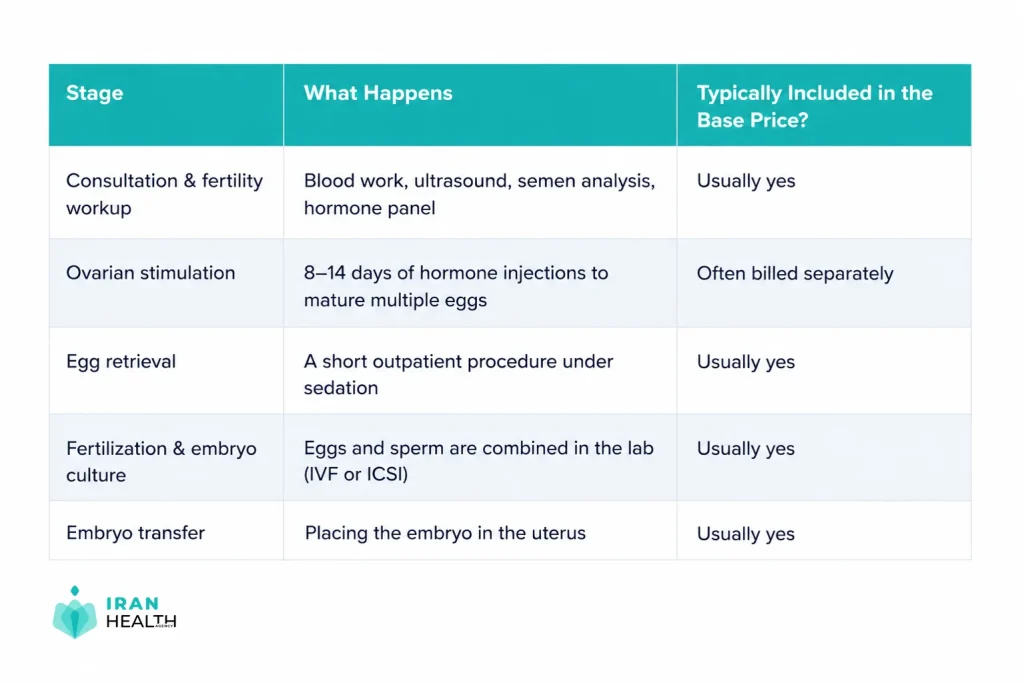
what actully included in the ivf cost in India

The gap between the advertised base price and the real out-of-pocket total is almost always the medication line item, daily gonadotropin injections that can add ₹40,000 to ₹1,20,000 depending on dosage and whether you use branded or generic drugs. This pattern is consistent across most 2026 clinic pricing pages, including breakdowns from Cloudnine Fertility and Dr. Hrishikesh Pai’s clinic group.

IVF cost in India by treatment:

As we said earlier, the cost of IVF in India depends on the IVF treatment type, clinic location, and extra procedures you may need to treat your infertility issues.

Here’s a breakdown of the approximate costs for various IVF treatments in India, both in dollars and Indian rupees. The cost below shows you each test tube baby treatment with all the cost components, including the consultation, medical process, and medication price!

1. Standard IVF Cycle:

  • Cost: ₹90,000 to ₹250,000 (approximately $1,100 to $3,100) per cycle.
  • Consultations, ovarian stimulation, egg retrieval, fertilization, and embryo transfer.
  • Note: Medications, diagnostic tests, and additional procedures may incur extra charges.

2. Intracytoplasmic Sperm Injection (ICSI):

  • Cost: $4,250 to $4,900 per cycle.
  • Includes standard IVF procedures plus the ICSI technique, where a single sperm is injected directly into an egg.

3. Intrauterine Insemination (IUI):

  • Cost: $410 per cycle.
  • Includes sperm preparation and insertion directly into the uterus.

4. Frozen Embryo Transfer (FET):

  • Cost: $1,600 per cycle.
  • This includes thawing and transferring previously frozen embryos.

5. Egg Donation IVF:

  • Cost: $4,900 plus $1,000 donor cost.
  • Includes: use of donor eggs, standard IVF procedures, and associated donor expenses.
  • Frozen Donor Eggs Base Cycle Fee: Rs 1,00,000 to Rs 1,50,000+
  • Fresh Donor Eggs Base Cycle Fee: Rs 70,000 to Rs 2,00,000+

6. Embryo Donation:

  • Cost: $4,900 plus $1,000 donor cost.
  • Includes: Use of donated embryos for transfer.

7. Natural Cycle IVF:

  • Cost: ₹90,000 to ₹250,000 (approximately $1,100 to $3,100) per cycle.
  • Includes IVF without ovarian stimulation, focusing on the natural selection of eggs.

8. Minimal Stimulation IVF:

  • Cost: ₹90,000 to ₹250,000 (approximately $1,100 to $3,100) per cycle.
  • Includes: Lower doses of stimulation medications to produce fewer eggs.

Additional Costs:

  • Medications: ₹20,000 to ₹40,000 (approximately $240 to $480) per cycle.
  • Diagnostic Tests: ₹5,000 to ₹10,000 (roughly $60 to $120).
  • Embryo Freezing: ₹ 20,000 to ₹ 30,000 (approximately $240 to $360) for initial freezing; storage fees may apply.

For context on why this matters: a comparable cycle with medication runs $12,000–$25,000 in the United States. So even at the higher end of Indian pricing, international patients are typically looking at 70–85% savings versus US costs for clinically similar care, a gap wide enough that even with flights and a 2–3 week stay factored in, the total is usually still lower.

 IVF costs in some major Indian cities:

Location changes the bill more than almost any other single factor, and not because the medicine is different it’s rent, staffing costs, and specialist concentration:IVF cost in india for major cities
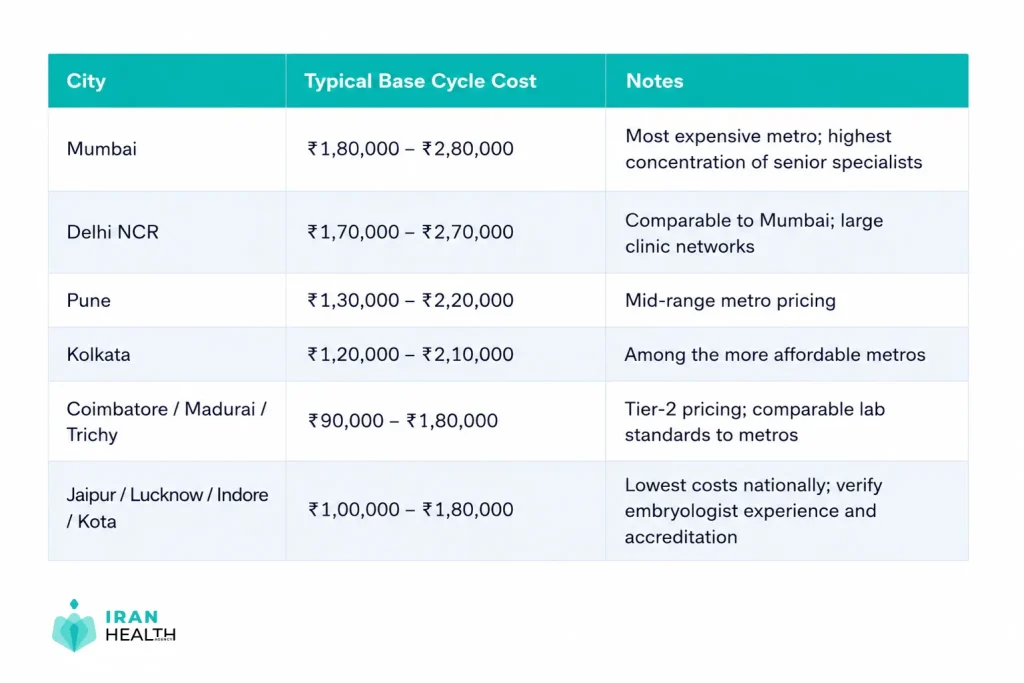
The consistent finding across multiple 2026 pricing surveys, including Crysta IVF’s city-wise breakdown and Sudha Fertility Center’s cost guide, is that tier-2 cities offer the cheapest IVF in India without a meaningful difference in success rates, as long as you verify the clinic’s NABH or equivalent accreditation and the embryologist’s individual case volume.

IVF Success Rates in India: What the Cost Actually Buys You

Cost only matters relative to what it buys. India’s own ICMR–NIRRCH research confirms that even public-hospital cycles now regularly exceed ₹1,00,000, underscoring that India’s low pricing reflects lower operating costs rather than a stripped-down protocol. As a general pattern reported across multiple Indian fertility centres in 2026, women under 35 using their own eggs see live birth rates in the 50–60% range per cycle, broadly in line with the under-35 outcomes reported by the US CDC and Europe’s ESHRE registry for comparable patients though, as with any country, always ask a specific clinic for its own age-banded data rather than relying on a single blended average.
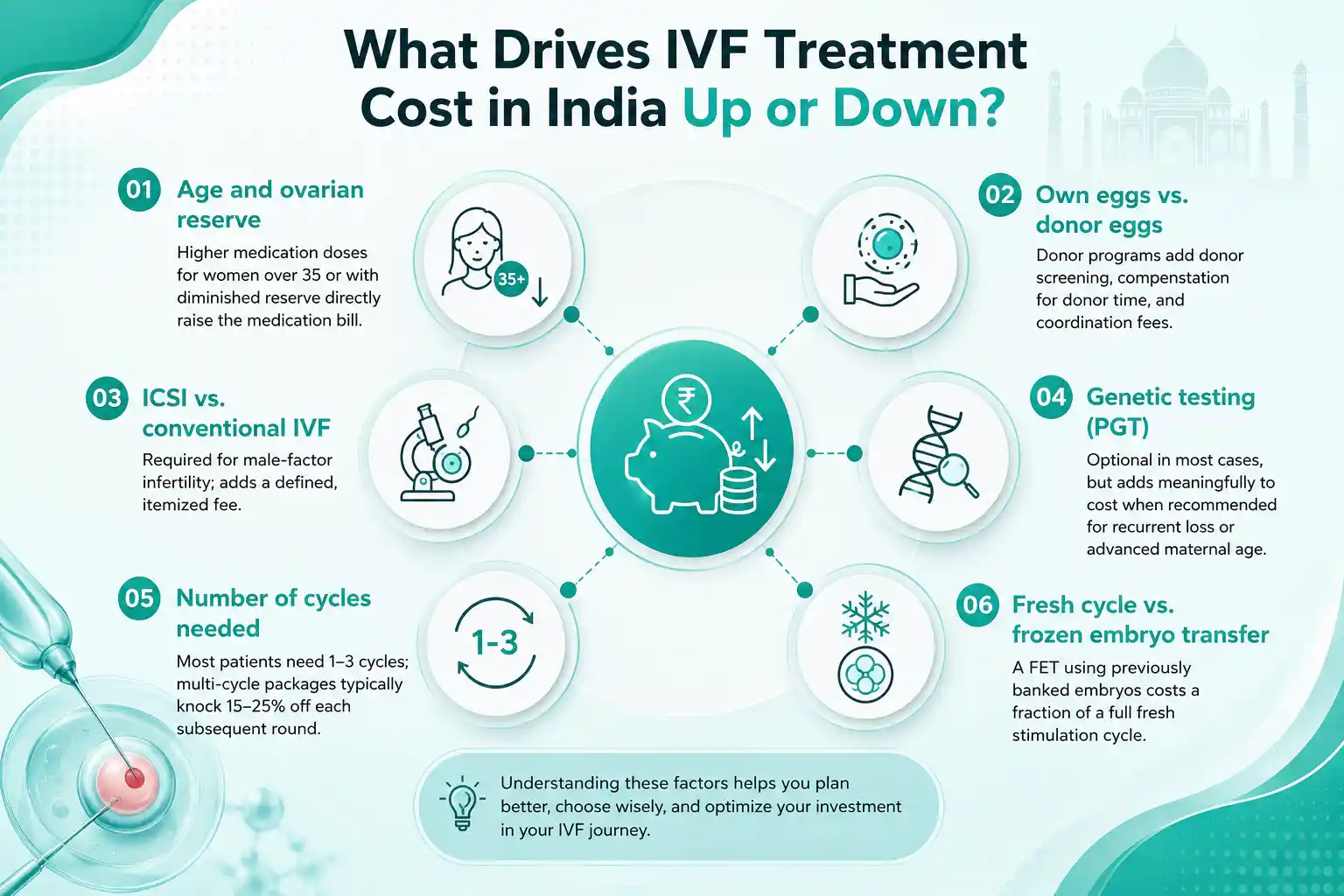
What Drives IVF Treatment Cost in India Up or Down?

Does Insurance Cover IVF Cost in India?

Mostly, no, and this is worth planning around rather than discovering mid-treatment. Standard Indian health insurance policies still largely exclude infertility treatment, though a small but growing number of corporate group policies now include partial fertility riders. Government employees have one narrow exception: the Central Government Health Scheme (CGHS) offers a one-time reimbursement of up to ₹65,000 across three fresh IVF cycles for eligible beneficiaries. A few state governments, Tamil Nadu, Rajasthan, and Goa among them, also run limited free or subsidized IVF schemes for lower-income couples through public hospitals, though eligibility is means-tested and mainly restricted to Indian residents rather than international patients.

IVF cost  in India for foreigners

Before comparing IVF cost in India for foreigners, it’s worth knowing what’s actually legal, because this affects which clinics can treat you and what paperwork to expect. India’s Assisted Reproductive Technology (Regulation) Act, 2021, governs this, and its FAQ document confirms that international patients can access IVF services in India provided they meet the medical and legal criteria (ART Act FAQ, Government of India).

  • IVF itself: legal for foreign nationals, including single women and married couples, once age and medical criteria are met.
  • Age limits: 21–50 years for the woman, 21–55 years for the man, per the Act’s eligibility bands, as summarised by Drishti IAS’ policy explainer.
  • Egg/sperm donation: legal and regulated donors are screened and cannot donate anonymously or more than once.
  • Surrogacy: this is the one major exception. Commercial surrogacy is not available to foreign nationals in India (only altruistic surrogacy for eligible Indian citizens, with narrow exceptions for OCI cardholders) so if your fertility plan may eventually involve a gestational carrier, confirm this with a clinic’s legal team before committing to treatment in India.
  • Clinic registration: only clinics registered with the National ART & Surrogacy Board are legally permitted to treat patients, so it’s worth asking for a registration number before booking.

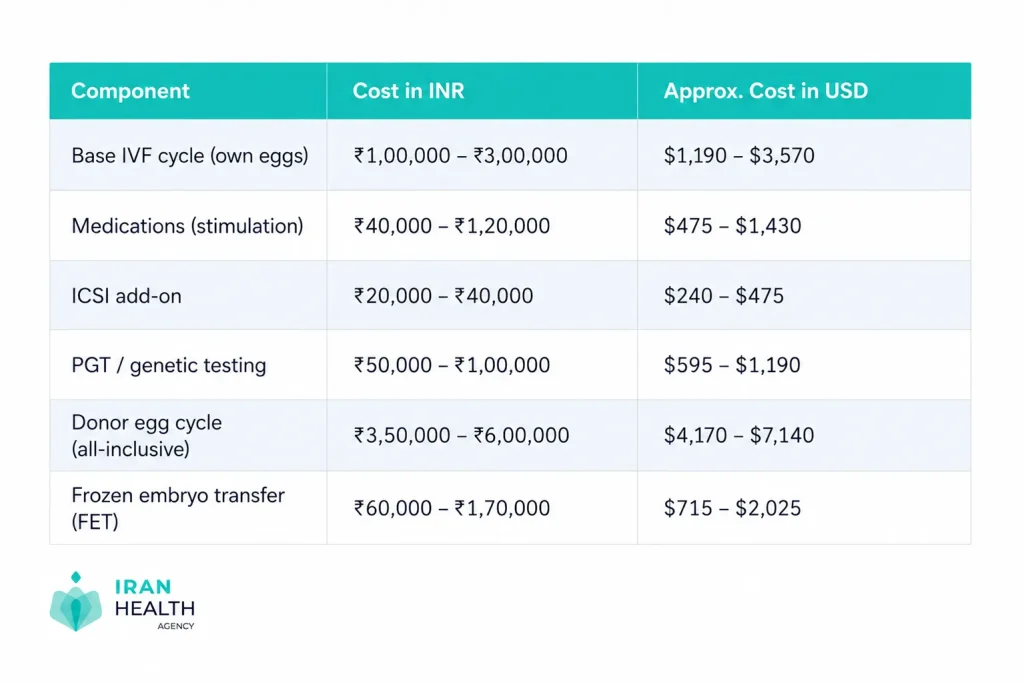
So let’s see the IVF cost in dollars for foreigners:

IVF Cost in India in Dollars: What International Patients Actually Pay

For patients researching IVF cost in India in dollars, it helps to see the rupee ranges converted at a realistic 2026 exchange rate (roughly ₹84 to $1) rather than relying on a single number pulled from a marketing page:IVF Cost in India with Dollars
 

IVF Cost in India vs Iran: Which Country Offers Better Value?

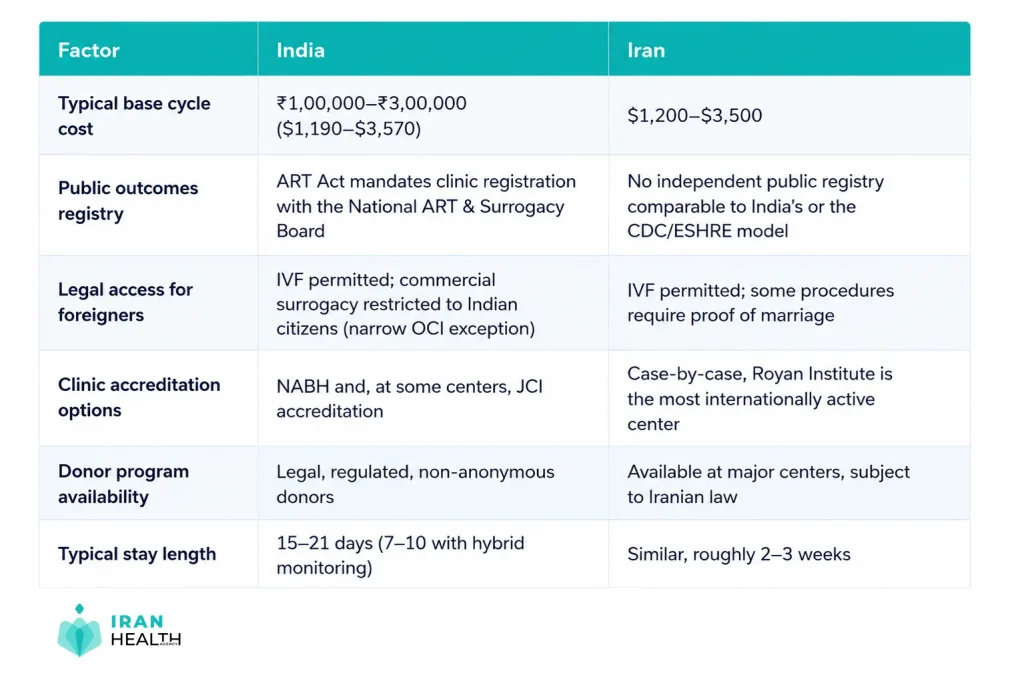
India and Iran are consistently the two countries that show up together in the cheapest country for IVF comparisons, so it’s worth putting the numbers side by side rather than guessing:
IVF cost in India VS Iran

On raw sticker price, the two countries land in a similar range. The meaningful difference is verifiability: India’s ART Act, in force since 2021, requires every clinic to register with a national board and follow standardized eligibility, donor, and record-keeping rules, which gives patients a paper trail and a regulator to complain to if something goes wrong. That regulatory layer is a genuine part of value, not just price, and it’s why India tends to edge out Iran for patients who weigh transparency heavily. For a broader look at how these two destinations stack up against Spain, the Czech Republic, and other options, see our full comparison guide on the cheapest country for IVF.

How to Budget for IVF in India: A Realistic Total

Most couples should plan for ₹2,00,000 to ₹6,00,000 (about $2,400–$7,150) across one to two cycles, including medication and the most common add-ons not the ₹1,00,000 headline figure most ads lead with. Before booking, ask each clinic for:

•  A fully itemised, all-inclusive quote (medication, monitoring, and a frozen transfer included or excluded)

•  Its NABH or equivalent accreditation and registration number under the ART Act

•  Age-banded live birth rates, not a single blended success percentage

•  What a second cycle or frozen transfer costs if the first attempt doesn’t succeed

Free Consulation

Frequently Asked Questions

How much does IVF cost in India?

A base cycle typically costs ₹1,00,000–₹3,00,000 ($1,190–$3,570). With medication and common add-ons, most patients spend ₹1,80,000–₹4,50,000 per cycle.

Is IVF cheaper in India?

Yes a comparable cycle with medication costs $12,000–$25,000 in the US, so India typically offers 70–85% savings for clinically similar care.

How much IVF cost in India in dollars?

Roughly $1,190–$3,570 for a base cycle, or $4,170–$7,140 for a donor-egg cycle, at a 2026 exchange rate of about ₹84 per US dollar.

Is India good for IVF?

For most patients, yes: India combines regulated clinics (registered under the ART Act, 2021), internationally trained specialists, and costs a fraction of Western pricing though always verify individual clinic accreditation.

Is medication included?

Usually not in the base package. Stimulation medication typically adds ₹40,000–₹1,20,000 and is the most common source of surprise costs always ask for an all-inclusive quote.

Can foreigners get IVF in India?

Yes. IVF is legal for foreign nationals who meet the ART Act’s age and medical criteria (21–50 for women, 21–55 for men). Commercial surrogacy, however, is restricted to Indian citizens.

Which city has the cheapest IVF?

Tier-2 cities such as Jaipur, Lucknow, Indore, Kota, and Coimbatore generally offer the lowest base costs (₹90,000–₹1,80,000) with clinical standards comparable to metro clinics.

Is IVF cheaper in India or Iran?

The two are broadly comparable on sticker price ($1,190–$3,570 in India vs. $1,200–$3,500 in Iran); India’s edge is a more formal, ART Act-regulated registration system for clinics.

Which country has better IVF success rates: India or Iran?

Neither country publishes an independent public outcomes registry comparable to the US CDC or Europe’s ESHRE, so clinic-quoted success rates in both countries should be requested directly and treated as self-reported until verified.

Should I travel to India or Iran for fertility treatment?

Both offer major cost savings versus Western countries. India’s ART Act registration system gives patients a clearer regulatory paper trail; Iran’s Royan Institute offers deep, research-backed clinical experience. The right choice depends on your specific diagnosis, donor needs, and how much weight you place on independently verifiable data.

0 0 votes
Article Rating
0 Comments
Oldest
Newest Most Voted
Inline Feedbacks
View all comments